Commentaries
A philosopher is placed beside a single photograph. Not to furnish an interpretation, but to think with the image—to follow the lines of thought it provokes beyond its own edges.
What follows are not readings in the conventional sense. There is no attempt to decode the image or declare its meaning. Instead, each commentary treats the image as a starting point: a place to introduce an idea, draw an unexpected connection, or share a philosophical insight.
Commentaries: Samet Durgun – Kris Goffin
Abstract
“What if photography is more about 'listening' than seeing?” Come Get Your Honey uses this question as a compass to tell a story about the LGBTQIA+ refugee and asylum seekers in Berlin. It is the artist's journey of weaving bonds at eye-level with individuals through vulnerability, friendship, and joy.
Samet Durgun strives to depict each individual as complex human beings in their wholeness, trying to establish a new home in a foreign country and in an extremely polarized political climate.
Philosopher’s Comment
This is an image from “Come Get Your Honey”, a photography monograph by Samet Durgun. It portrays “gender-nonconforming, queer, transgender refugees and asylum seekers in Berlin”. Durgun himself is a queer first generation immigrant, living in Berlin.
Durgun asks the question: “What if photography is more about ‘listening’ than seeing?” Here is my interpretation of that idea: “photography as listening” is photography that is interested in what lies behind the surface. One is interested in the perspective of the portrayed person. Photography as listening aims at creating art that conveys knowledge.
This idea is, I believe related to what Miranda Fricker (2007) calls “epistemic injustice”. Feminist philosophers have discussed the injustices in practices of knowledge production. In traditional ways of producing knowledge in our society, some people are considered to be more trustworthy knowledge givers than others. Some perspectives are taking more into account than others. The perspective from people from marginalized groups are often not taken as reliable sources of knowledge. This is a form of in injustice: epistemic injustice.
I believe that art might help to combat this injustice. One can argue that, for instance, to inform you about what it is like to be a queer refugee, the best access to knowledge comes from queer refugees themselves. One can thus try to “listen”, if one is willing to understand. In doing so, it is also important to reflect on whose gaze one is serving in the artistic process. Is one portraying people in relation to one’s own goals or is one trying to understand?
Let us go back at the picture: does Durgun succeed in creating an image that might combat the wrongs of epistemic injustice? One can argue that Durgun’s standpoint is still the perspective of an outsider. Durgun is not a refugee or asylum seeker himself, so he is not fully part of this community. However, Durgun is a queer immigrant, so there are still some points of connection. There is a common ground but also an opportunity to learn, to listen and to understand. I find that this might create an interesting dialogue between photographer and photographed.
However, one can think that it is a bit too much to ask from photography that it combats epistemic injustice. As the photographer is literally ‘seeing” and ‘not listening”, I wonder whether photography is really the best medium to combat epistemic injustice. I think that the “seeing” versus “listening” metaphor can almost be understood literally. Seeing does seem to portray the subject matter from an “outside” perspective, only grasping the surface of a person. Whereas it is only in a conversation with a person, only by “listening” what a person has to say that we can fully grasp that person’s perspective.
This image is a portrait of one person, who’s resting his head intimately on another person whose face is not shown. The image is accompanied by the text: “I started doing makeup once I needed to cover a bruise after my father beat me (laughs). My mom gave me her concealer”.
One can “see” the person in an intimate sphere, one can see that the portrayed person is loved and receives affection. However, we still see this scene from an outsider’s perspective. It is only thanks to the accompanying text that we get a grasp of the perceptive of the portrayed person. A whole story is implied in very few sentences. They describe abuse, and probably a change in gender expression as a response (or protest) to this abuse. The text might enable the spectator to “listen”. Thus text might be a more suitable medium to combat epistemic injustice, rather than portraying people whose voice you want to hear through photography, as in the latter case, you are still “seeing” a person from a particular perspective.
The sharp contrast between photography and text is, however, an abstraction. In the actual work of Durgun, the text and the portrait complement each other. In this way photography can also “listen”.
Fricker, M. (2007). Epistemic injustice: Power and the ethics of knowing. Oxford University Press.
-
PHOTOGRAPHER
Samet Durgun (b. 1988) based in Berlin, is German with a Turkish migration background and of Abkhazian descent. He holds a BA from Bogazici University, Turkey. As a first-generation immigrant and self-taught artist in Germany, he was recently a guest student at the College of Fine Arts Berlin (UdK), participating in Common Ground, a support program for artists who fled or immigrated to Germany. His artworks are shown in local and international exhibition venues, including the Berlin Museum of Photography.
sametdurgun.com -
PHILOSOPHER
I am a philosopher. My research focuses on philosophy of mind, philosophy of cognitive science, emotion theory, and aesthetics. I mainly work on emotions, art and implicit attitudes, such as implicit racist and sexist prejudices and stereotypes.
I am currently a postdoctoral researcher at UAntwerp and KULeuven. In October 2019, I started doing interdisciplinary research with a team of social psychologists from Agnes Moors’ Lab at KULeuven on implicit bias and implicit racism. I received a Postdoctoral Fellowship from the FWO (Flemish Research Foundation).
I took a break from this project during the academic year of 2020-2021, because I received the British Society of Aesthetics Postdoctoral Award, to do research on fiction, emotion and implicit attitudes at Birkbeck College (University of London).
I was a postdoctoral researcher at Thumos, which is part of the Swiss Center for Affective Sciences, at the University of Geneva (2018-2019). I received a Postdoctoral Swiss Government Excellence Scholarship to do research on emotion and implicit bias.
In 2018, I completed my doctoral studies in philosophy at UGent and UAntwerp, at Bence Nanay’s Research Group (Centre for Philosophical Psychology). My doctoral work is on emotion and mental content.
krisgoffin.com
Commentaries: Matthieu Gafsou – Bill D’Alessandro
Abstract
Vivants is a series that deals with the degradation of the world and our place in it. Rather than describing contemporary crisis (global warming, extinction of biodiversity, etc.) or hiding behind general concepts, the artist has chosen to thematise the intimate dimension of such a horizon. Vivants is certainly based on facts and theories, but the project also lets in feelings (anxiety, anger, love). It is a story of relationships: between subjects and their environment, between humans and non-humans. Through a variety of practices, ranging from documentary to Land Art to a more plastic approach (physical manipulation of prints with crude oil), Gafsou weaves a shattered, nocturnal web, studded with rare flashes of life. The artist’s approach, both formal and sensitive, blends his daily life and the people he loves with global issues, resulting in a twilight and powerful series.
You may see all the works here.
Philosopher’s Comment
In typical cases, we’re well acquainted with the subjective quality of our visual experiences. As I write this, for instance, I have a firm grasp on the pinkness of the lilies on my table, the brightness of the cloud-filtered light coming through my window, the shape of my hands resting on the keyboard. In reflecting on what I see, I’m perfectly aware that my experience contains each of these elements, and I know just what each one is like.
But some of the most interesting episodes of visual awareness aren’t like this. There are times when our visual experiences are, for one reason or another, not fully reflectively graspable in the moments they’re occurring.
For instance, a stimulus might be too intense to focus on for more than an instant, like a violently bright screen coming on in a dark room. Or it might shift, break up or mutate before we can attend to it properly, like a mesh of shadows playing across the windshield on a nighttime drive. Or, instead, there may be something going on in peripheral vision that doesn’t quite punch through to full consciousness, like the vague shapes of people passing on the sidewalk while we’re reading on the balcony. In these cases, I take it, we don’t and can’t achieve full awareness of the quality of our visual experiences while we’re having them.
I’ve often felt a desire to take a picture of my visual field in those instants—to try to preserve the semi-conscious, obscure, fleeting details of a scene that would be gone before I could really see it. This untitled image from Matthieu Gafsou’s Vivants series seems to me to take on the challenge. I read it as, among other things, a record of a perceptual moment that a viewer couldn’t have properly absorbed at the time.
Most obviously, there’s the blinding ring of sunlight reflected on the water just a few meters off—too bright to stare at if you’re there, but reduced to a manageable intensity by my computer screen. Squinting against the wind and glare, your field of view would be narrower than the generous angle of Gafsou’s lens.
The image also reflects the roughness of vision under suboptimal conditions. Neither the beach in the foreground nor the city lights in the distance are especially sharp. Indeed, it’s hard to tell which part of the image is in focus; the details throughout have a mushy, noisy quality that evokes the vagaries of eyesight rather than the pristineness of landscape photography. A more technically impeccable image would’ve looked less like being there.
There’s a natural connection here with recent discussions in philosophy about “privileged access” and the “luminosity” of our mental states. According to a traditional view, whenever we’re in a given mental state, we’re always in a position to know that we’re in that state; the details of our conscious lives are necessarily transparent to us. Following on the heels of influential work by Timothy Williamson, philosophers in the last couple decades have debated whether all, most or even any mental states are indeed “luminous” in this sense.
Thinking about photographs like Gafsou’s can help us see a potential problem with luminosity claims. Plausibly, my real-time visual experience of a scene like Gafsou’s beach contains many elements about which I’m in no position to gain reflective knowledge: there’s something it looks like to glimpse a blinding patch of sun moving irregularly across shallow water while squinting, but the scene is too complex, fleeting and sensorily overwhelming for me to fully grasp (and hence come to know about) the quality of my experience. In the photograph, though, I can see it all; the image represents, in a sense, what I could have come to know if my visual states were genuinely luminous.
Of course, putting things this way is a little careless. What’s recorded by the camera and displayed on my screen isn’t literally what Gafsou saw, or what I would have seen; a lens and sensor isn’t an eye and an image processor isn’t a brain. Appropriate caveats aside, though, I remain fascinated by the idea of photography as a tool not just for capturing what we see (and know we’re seeing), but for fixing in place the elusive, obscure, un-luminous qualities of perceptual experience. Gafsou’s Vivants offer powerful and moving explorations of this theme.
-
VISUAL ARTIST
Matthieu Gafsou (CH, F, 1981) lives and works in Lausanne, Switzerland. After completing a master of arts in philosophy, literature and cinema at the University of Lausanne, he studied photography at the School of Applied Arts in Vevey. Since 2006, Gafsou has participated in numerous group and solo exhibitions, and published five books. In 2009 Gafsou was awarded the prestigious “Prix de la fondation HSBC pour la photographie” and subsequently was invited to contribute to the Aperture Foundation’s 2010 reGeneration2 exhibition. In 2014, Lausanne’s influential Musée de l’Elysée hosted Gafsou’s solo show titled Only God Can Judge Me. In 2018, the H+ exhibition was one of the highlights of Les Rencontres de la Photographie in Arles. In parallel to his artistic practice, Gafsou is on faculty at the University of Art and Design Lausanne (ECAL).
gafsou.ch -
PHILOSOPHER
Bill D’Alessandro’s research is mainly on philosophy of math and science and metaphysics and epistemology, with occasional forays into other territory. Explanation, understanding and modeling in scientific practice are recurring themes in his work.
He is currently a postdoctoral fellow at the Munich Center for Mathematical Philosophy at LMU (Ludwig Maximilian University of Munich). He did his PhD in philosophy, and an MS in math, at the University of Illinois at Chicago.
Commentaries: Mishka Henner – Maarten Steenhagen
La balance, from the series Open Spaces, inkjet print in floating white box, 13.7 × 18.5 inch. © Guillaume Martial, 2022.
Philosopher’s Comment
Computer art is no longer a thought experiment. It’s everywhere. It’s no surprise to find this technology used by an artist like Henner, who has built up a provocative portfolio of works that are but also are not made by Henner himself. The Fertile Image makes use of GAN software to generate endless series of similar looking images, each time taking some two input images as starting point. The work has the appearance of a 1970s conceptual photography presentation.
But the interesting thing is, these aren’t actual photographs. They merely look like photos. Henner’s ‘fertile’ images subvert the expectations we have of photographic representation. In the descendant images of Parent Set #1, I immediately recognise a type of scene: modern architecture; a deserted house; draperies. Yet as soon as I examine these pictures, their representation falls into incoherence. The details just don’t add up. Walls are wrinkled like curtains, shapes become shadows (and vice versa), and what seemed architectural elements turn out to be mere abstractions. The incoherence of these images is unsettling. When you step back and look at them from a distance they once more appear like ordinary (be it somewhat artsy) Polaroid snaps.
The fact that the “fertile” images are photographic merely at the surface is interesting, but it’s no more than an artifact of the way GAN software works. Although some uses of GAN result in deceptively “real” pictures (thispersondoesnotexist.com is a case in point), the software most commonly gives you something that is, to some extent, garbled. This has become the aesthetic of much of present-day computer art: surrealistic, dreamlike compositions of elements taken from other pictures. (Philosophers have for centuries thought that the human imagination works in this synthesising way as well.)
However, The Fertile Image goes beyond computer art. It merely uses it. We also see the results of choices made by Henner: the grid presentation, the use of tiny archival envelopes, and perhaps which images served as input for the generative algorithm. These aesthetic choices ensure the ‘photographicity’ of the work. They allow us to see these images as art, and read them as a commentary on the aesthetics of art photography, as it became established in the 1970s. With the emergence of ‘artificial photographs’, does art photography still have a future?
-
VISUAL ARTIST
Mishka Henner is a visual artist born in Belgium and living in the UK. His varied practice navigates through the digital terrain to focus on key subjects of cultural and geo-political interest. He often produces books, films, photographic, and sculptural works that reflect on cultural and industrial infrastructures in a process involving extensive documentary research combined with the meticulous reconstruction of imagery from materials sourced online.
His work has featured in group shows at the Museum of Modern Art, the Metropolitan Museum of Art, New York, Centre Pompidou, Paris and Centre Pompidou Metz, Victoria & Albert Museum, London, Pinakothek der Moderne, Munich, Hasselblad Foundation, Gothenburg, Ullens Center for Contemporary Art, Beijing, FOAM Amsterdam, and Turner Contemporary, Margate. He holds a Masters degree from Goldsmiths College in London and in 2013, was awarded the Infinity Award for Art by the International Center of Photography. He was shortlisted for the Deutsche Börse Photography Prize in the same year and in 2014, was on the shortlist for the Prix Pictet for his large-scale works focusing on landscapes carved by the oil and beef industries of America.
mishkahenner.com -
PHILOSOPHER
Maarten Steenhagen is a researcher in the Department of Philosophy at Uppsala University. Prior to coming to Uppsala he worked as a lecturer at the University of Cambridge and was a Bye-Fellow of Queens’ College.
His current research focuses on perception and aesthetic value. In particular, he concentrates on the metaphysics and normativity of appearances. He also writes about the role of perceptual media in experience—such as sounds, images, and optical technology. His articles and papers cover the experience of sounds, images, and mirror perception, as well as evaluations of the different theories of perception.
In addition to his work on perception, Steenhagen is interested in philosophical logic and the history of 20th century philosophy, in particular the controversies about philosophical method and the presuppositions and value of analysis in philosophy.
msteenhagen.github.io
Commentaries: Guillame Martial – Michael Spicher
La balance, from the series Open Spaces, inkjet print in floating white box, 13,7 × 18,5 inch. © Guillaume Martial, 2022.
Abstract
Open Spaces is a photographic project put together in prison setting. On a beautiful summer’s day in Burgundy, Guillaume Martial set out to photograph the Varennes-le-Grand prison, on the outskirts of Chalon-sur-Saône in France. Upon reaching the walls of the prison, he set up his equipment and opened the shutter. As if by magic, this action pierced the stone to reveal the first photograph taken in world history by Nicéphore Niépce – Point de vue du Gras, an image dating back to 1827, revealing this very prison site to the world. Wow! In this familiar picture, you can see the prison yard, its architecture and the two watchtowers of the jail. Is it a mystical vision? Or an optical illusion? Has perception merged with reality?
This project was produced at the Varennes-le-Grand prison, in collaboration with the Nicéphore Niépce museum in Chalon-sur-Saône.
Philosopher’s Comment
Guillaume Martial shot his latest photography series ironically titled, Open Spaces, inside and outside of Varennes-le-Grand prison. This particular photo “La Balance” presents the photographer at the corner with the markings of the Vitruvian Man.
His position at an outer corner of the prison demonstrates visually the way the building diminishes incarcerated persons. By placing his face close to the wall, Martial conjures the spirit of how painter Barnett Newman wanted people to view his work: by standing inches from the canvas so that you couldn’t see the edges, thereby inducing the sublime. The sublime, according to Immanuel Kant and Edmund Burke, provokes a feeling of awe often coupled with terror. Beholders feel their smallness in the universe. The sublime, in a way, puts the beholder in their place, which encourages humility and humanity. In the prison context, tension arises between the confining space and the seemingly endless time someone spends in prison, which squeezes out a person’s humanity. This is captured by Martial’s position in his photograph as each wall points toward an invisible horizon line in the distance. Only the bottom of the wall is in view.
The Virtuvian Man drawing sought to connect the human with nature, according to Leonardo da Vinci’s words. One thing suggested by the specific markings of the circle inside of a square is the human need for variety in lived spaces. Prisons fail in this regard, which can leave formerly incarcerated persons to struggle in various spaces upon release. Francis Hutcheson asserted that “uniformity amidst variety” contains an important aspect of beauty. Too little variety leads to boredom; too much variety leads to chaos. Variety, in Martial’s photo, is suggested subtly by the rectangle and circle, angles and curvature. Spaces that are overly monotonous deflate a person’s humanity; recent studies, for example, evince that a building’s blank facade affects people negatively, compared with a facade with some detail. People need variety to overcome boredom.
Martial adds a triangle below his photograph, which introduces the idea of its title: balance. In aesthetics, balance (or harmony or proportion) often refers to the physical qualities something possesses. And human proportion is suggested by the Vitruvian Man markings. However, I’m drawn to a metaphorical understanding, meaning the practical concerns of balancing the punishment of incarcerated persons with the desire for them to reintegrate into society afterward. Prison reform concerns a multitude of issues, but one that is neglected is aesthetics. The desire for aesthetics is a basic pleasure. Depriving incarcerated persons of this basic pleasure further removes them from what it means to be human. While acknowledging that restrictions and safety are necessary, the prison system ought to consider how aesthetic details could be integrated.
In this complex photograph, Martial visually creates an empathic vision of incarcerated persons. Spaces impact our well-being, so it’s not surprising that the space in prison damages people who are confined within its walls. This photo exemplifies their humanity.
-
VISUAL ARTIST
Guillaume Martial is a French artist, video maker and photographer. After ten years of figure skating in his childhood, he studied film and animated image. In 2009, he directed the making of Jour de Fête’s house, place dedicated for Tati’s film in Sainte-Sévère-sur-Indre. Inspired by burlesque cinema, sport or circus’s world, Guillaume MARTIAL constructs visual narratives with the space by interpreting characters with poetry and humor. His work raise the question of the place of the man in his environement. In 2013, he joined the collective project France(s) Territoire Liquide, published by Le Seuil and exhibited in BnF, french national library. In 2015, he received the HSBC award and published the monograph Slap-Stick by Actes Sud. His work is regularly exhibited in galleries, festivals and international institutions. He pursues his personal researches during artist residencies, accepts private and public commissions and teaches with several publics. He lives and works in France.
guillaumemartial.fr -
PHILOSOPHER
Based in Boston, Michael R. Spicher, PhD, works as a writer, educator, and philosopher, mainly focused on art and aesthetics. He has published articles on beauty, taste, aesthetic experience, and state support of the arts. Currently, he is working on two book projects: one on aesthetic taste and the other on digital fashion (with two colleagues). He teaches at Boston Architectural College and Massachusetts College of Art and Design, and previously taught at University of South Carolina and Boston University. Along with his own writing projects, he is an editor for the Leonardo Electronic Almanac (published by MIT Press) as well as the Internet Encyclopedia of Philosophy. Committed to advocating and educating for the value and pervasiveness of aesthetics, he founded the Aesthetics Research Lab.
Commentaries: Mumuko – István Zárdai
Abstract
“It’s war, let’s marry” is a multimedia art piece that tells the story of a war-torn Ukraine through a series of photographs, recorded sounds, war diary taken by MUMUKO during her two visits to the country. This exhibition presents a photographic installation entitled “War Wedding” that attempts to capture the reality of war as seen by an artist, rather than a journalist. In Japan today, where there is a lack of a sense of reality about this war, it seemed to me that it would be better to express “war” as a real fantasy. In this huge fantasy of a war wedding, we were made keenly aware that war is still a fantasy for us, and the exhibition expressed the tenuousness of our “living”, the sinfulness of it, the shallowness of it, the thoughtlessness of it, and the nature of humanity, which has no choice but to accept everything, whether war or peace, and move forward.
Philosopher’s Comment
Sometimes philosophy lifts the veil on the workings of our emotional lives at the core of our personality, and enables us to understand something bigger. The photos and the philosophical ideas I write about are I think both surprisingly relevant to current political tragedies—Russia’s brutal war on Ukraine, and the IDF’s ravaging of Gaza. Here is something surprising: during wars people suffer, are displaced, and lose their loved ones. If one doesn’t think about it more carefully, it is easy to say ‘I would have run away, I wouldn’t have stayed in a place following its bombing.’ But would we really do so? How is it that Ukrainians go on living in their cities despite shelling, that Gaza hasn’t been deserted a long time ago?
Japanese photographer Mumuko spent time in Ukraine during 2022–23. Her series titled ‘There is a war, let’s marry’ was exhibited at the Tokyo Photographic Art Museum in Ebisu (TOP). The photos show people making food, dancing, partying, having conversations in front of burnt-out tanks. The war is omnipresent: blackened, crumbling buildings, holes in roofs torn by explosions. One of the most arresting of her photos shows a massive bomb site in the playground. People nevertheless take their kids to play there.
The impact site is surrounded by people. They take a look, and then carry on. They came to let their kids have a chance to relax and burn some energy running and playing. The photo—as all of Mumuko’s photos—are vibrant. Colours are vivid and saturated; people are interacting; energy is abundant. The sky is blue, the lovely old building in the background is a pleasant fresh creamy yellow, the intense autumn leaves make us feel the fresh sharpness of the air.
Still, an ambiguity permeates everything. Parents and children stay close to each other. A child in the foreground looks across the photo, to something outside the frame, and assumes a strangely motionless position. As in many of Mumuko’s pictures the figures in the foreground seem to be lit up. The flash evokes the light of an explosion, when someone becomes the focus of all attention for a second. Is the picture oozing positive energy, or alertness, readiness, nervousness? This duality creates an interesting tension: the will to go on with life and enjoy it, and the weariness both appear fleeting, as if ready to intensify or become extinguished in a second. The camera seems to transport us into this setting, making the viewer experience the same ominous mood. That the pictures speak so honestly of the life of besieged people makes the question even more urgent: why stay, why go on with your routines during times of war? I think this is the point where—to our second surprise—we can turn to philosophy of action for an answer.
One of the most exciting of our unique human abilities is our decision making, enabling our freedom and autonomy. This comes at a price of course: if we would have to decide about every little thing at every junction of our lives, freedom would be unbearable.This is why routines, habits, and a somewhat stable core of personality help.When we think—reason—about what to do,we usually form long-term plans and preferences. These provide the skeleton of our personality: our lasting character traits—sometimes called policies—which give a structure to our decisions. Every time we decide something—often unconsciously and very quickly—the basic decision policies we formed help structure such choices. Plans, values, and preferences help us save time and energy. This stable existence throughout time is called diachronic agency. It makes it possible to carry out long-term projects requiring commitment like writing a book, bringing up children, developing a new product, participating in social movements.
This is the answer as to why people go on with their lives and don’t run: the paralysing lack of knowledge of the future that is so well captured in Mumuko’s photos makes people yearn for more stability. And the sturdiness of our agential structure—the set of stable core motivations and policies—provides this stability. New facts—new reasons—do move and change us. But they do that mostly gradually, unlike at the stroke of a magic wand. Philosophy of action helps here to spell out what the inner workings of our personality are—the needed ballast of stable motivations to anchor the freedom of our decision making ability—that shed a light on what we see happen in Ukraine and Gaza. People rarely run away until they’re forced to, and seek to get on with their work, their routines. And even fall in love, marry, and have children.
-
PHOTOGRAPHER
Born in China and came to Japan for college. When she was 20, she felt “Not Chinese enough without life in college in China. Not Japanese enough without life before college in Japan. Mix the two? Well, South America sounds perfect!”. So, she left, for Argentina, alone. In the years she stayed there, she learned that love and violence, freedom and poverty go hand in hand with each other. Lived with a shaman in the Amazon, Mumuko’s past life as seen through therapy was apparently “a witch in rainbow colors”.
“I want to see the view that only those who reach high ground can see.” That’s the starting point of her production. For freedom, she left her country, left her home, living out of one suitcase. Since COVID, she’s been talking more to animals and plants. Swimming freely like a transparent (and poisonous!) jellyfish, “I’m not qualified to be a human yet.”, she laughs, and continues her journey.
Mumuko sublimates suffering and cruelty into brilliant entertainment. She is an artist who continues to search for the possibilities of expression while riding the waves of the times.
mumuko.com -
PHILOSOPHER
A researcher in philosophy and ethics, with a deep interest in politics, international relations, literature and other social and human concerns. He currently lives in Japan and works as a lecturer at Juntendo University. He is also a visiting researcher at Keio University, and collaborates with the Tokyo Institute of Technology, Soka University, and the High School of Kogakuin University.
His current focus is on understanding Group Agency and Responsibility, aiming to provide a theory of what group agents (like states, militaries and companies) are, and how and why we should attribute responsibility to the individuals working in key positions in these organisations, and also to the organisations themselves. He is also actively working on the ethics and nature of war, moral psychology, and teaching methods.
zizardai.weebly.com
Commentaries: Sarah Ritter
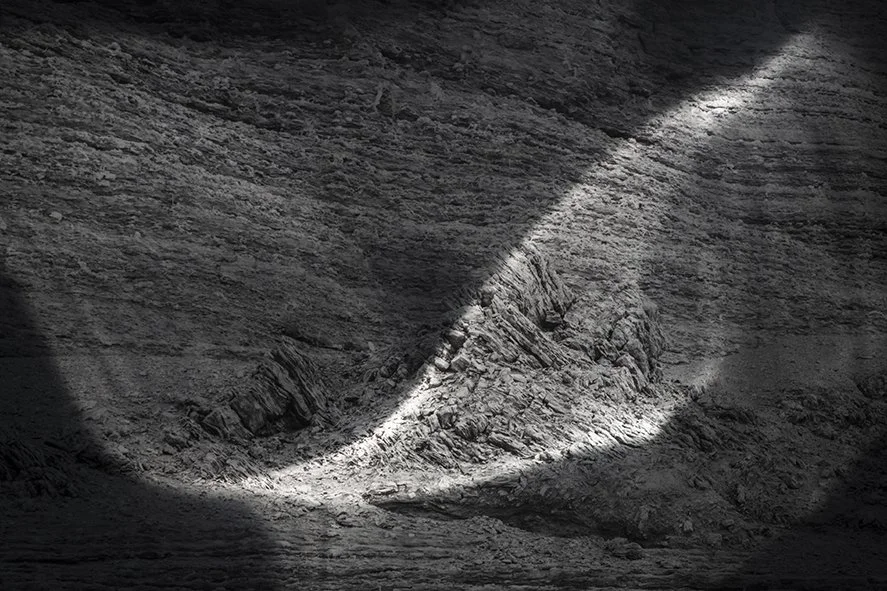
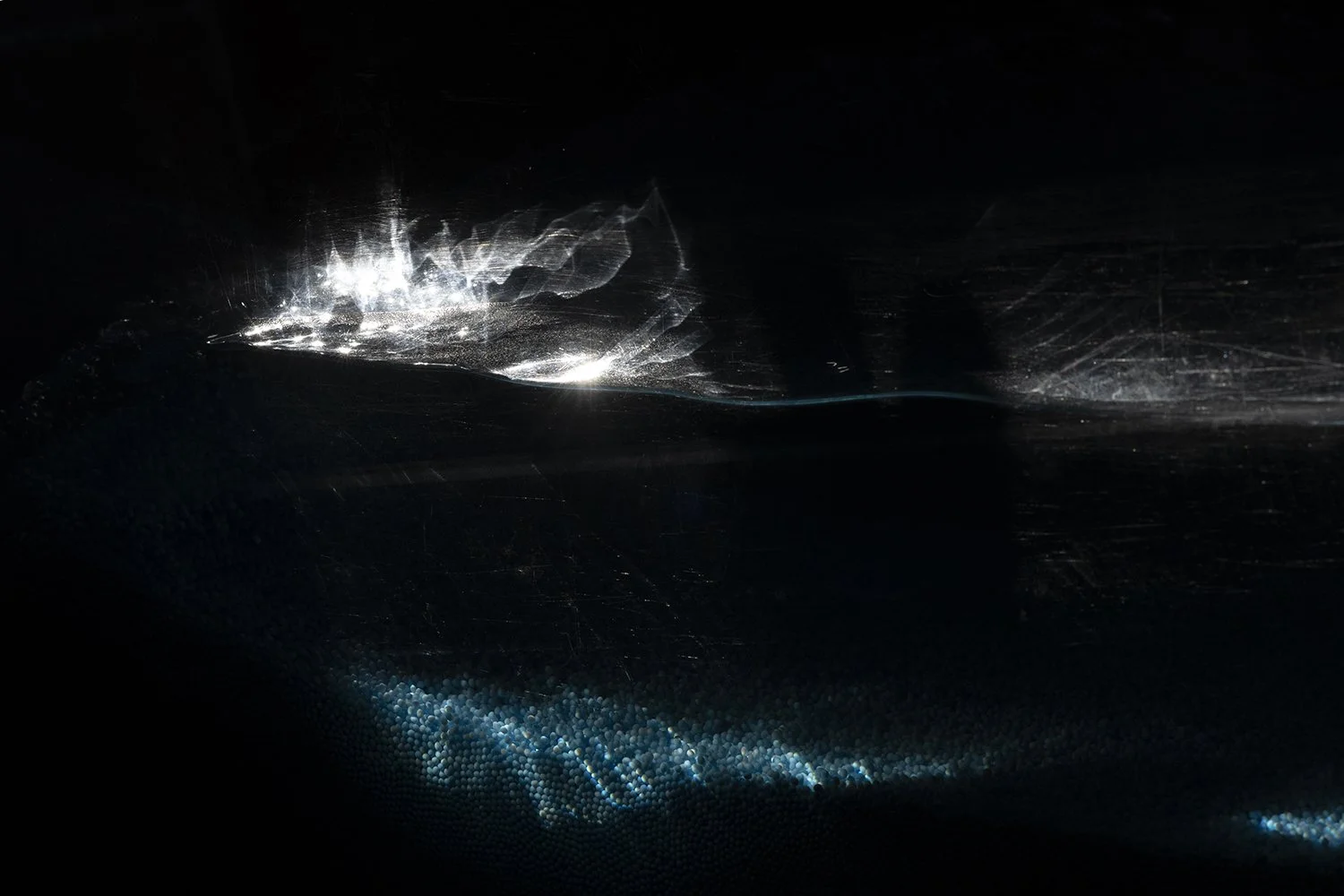
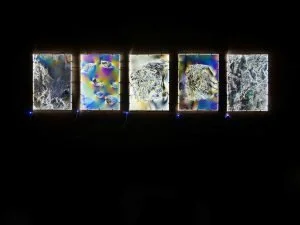
Abstract
These are the first lines of a text written on French photographer Sarah Ritter’s work in Photomonitor:
What counts when we are talking about an image? “[…] what counts, faced with an image, is not ‘what we are talking about’. What counts is the dance itself—of my gaze and my sentences—with the image. It is a question of rhythm”, writes Georges Didi-Huberman. It is through this rather poetic position that it might be interesting to initially approach French photographer Sarah Ritter’s work and tap into the rhythm not of her own projects, but of the “Collecte” (Collection) of images and quotes curated and hosted on her site. […]
[To read the rest of the text please visit the link here]
-
VISUAL ARTIST
Sarah Ritter became an artist after studying philosophy with Jean-Luc Nancy and photography at the National School of Photography in Arles. Her artistic practice is process-oriented; for each project, she aims at developing the proper way of making and showing images according to each topic. This approach has led to projects that explore landscapes, memory, and narrative, often through extended research phases and residencies, including trips to Detroit, Shanghai, and Costa Rica. Her first monograph, La nuit craque sous nos doigts, was published with Loco editions in 2019. She also edited the book Wild Rumors, Moby-Dick, Detroit et autres récits in 2023 (Loco Editions), which was the outcome of an art research project based on Melville’s book, in collaboration with writers, artists, philosophers and sociologists. Her work is part of several public and private collections in Europe—including the MACVAL, the Bibliothèque Nationale de France, and multiple Fracs—and is regularly exhibited in France (solo and collective) and in other countries (collective shows in Finland, Germany, Slovakia, Mexico, Argentina). Ritter has received several major grants and prizes, including the 2023 Research Grant from the Bourgogne-Franche-Comté region, the 2022 Grant from the Fondation des Artistes, the 2021 Institut pour la Photographie des Hauts-de-France research program, the BNF’s “Radioscopie de la France” major commission, and the Schneider Foundation Contemporary Talent Prize. Her work has also been supported by the CNAP national commission and the Casa de Velázquez.
Commentaries: Julie Scheurweghs – Hans Maes
Abstract
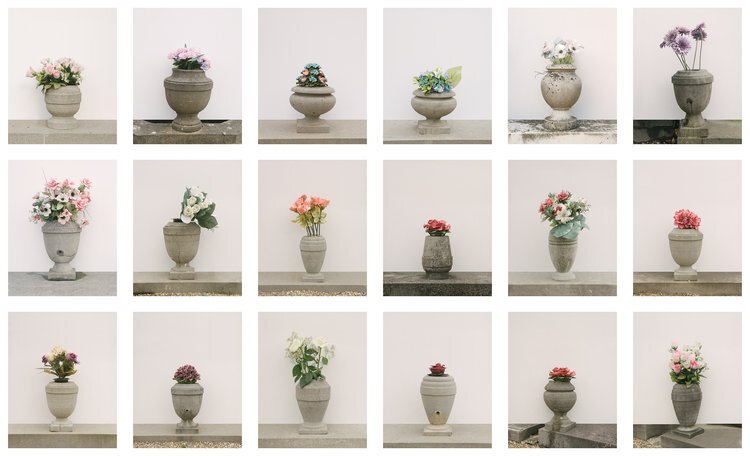
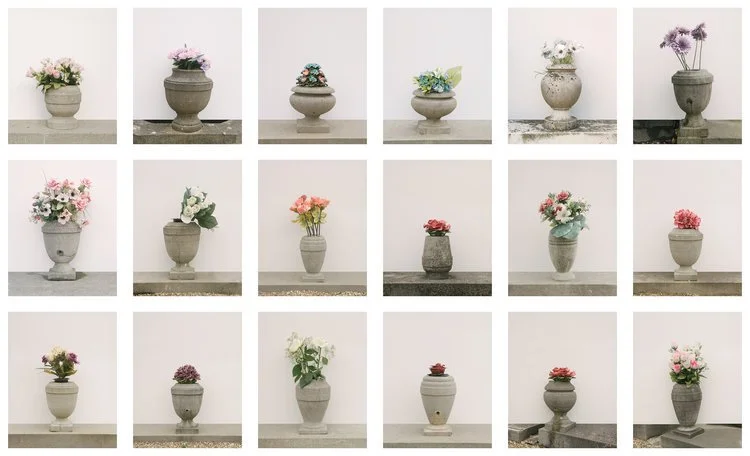
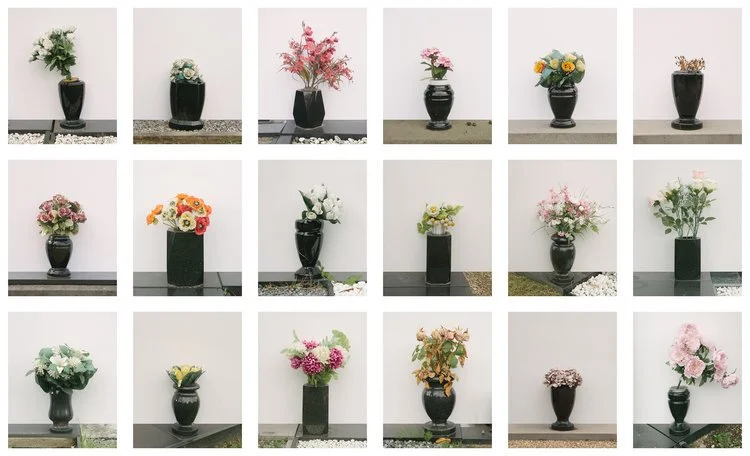
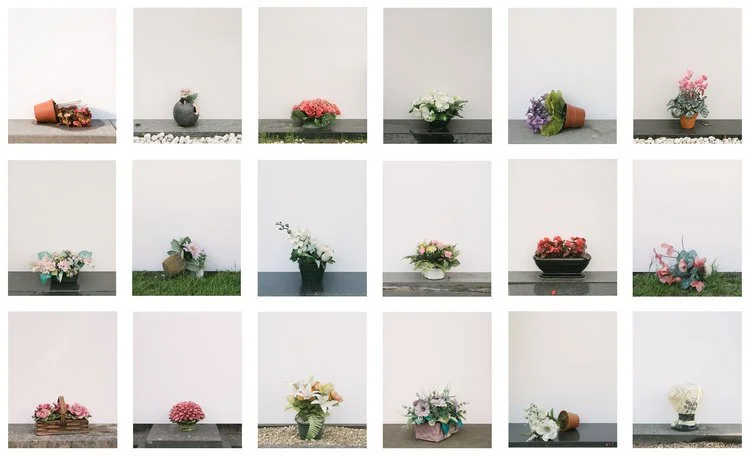
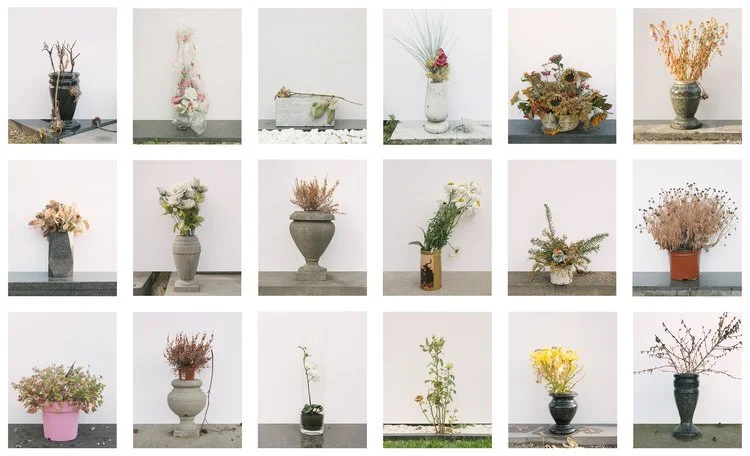
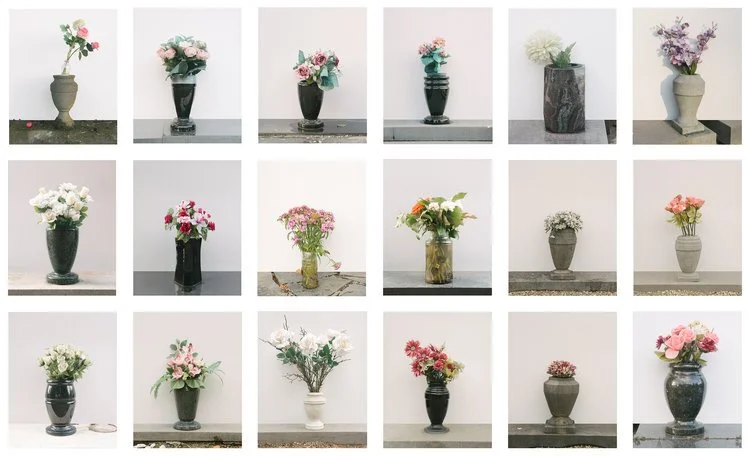
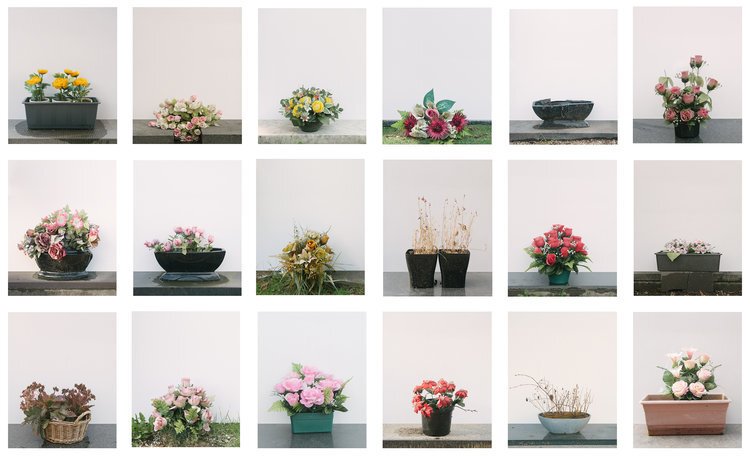
In Memory’s Garden (2014) is a study in funerary photography. Photographs of flower bouquets adorning individual graves are juxtaposed with photographs of the small enamel portraits one often finds on Belgian gravestones. Many of these older pictures have now faded beyond recognition. As such, they exemplify one of the great paradoxes of portraiture, namely, that portraits often serve as powerful reminders of the inevitable oblivion that awaits us all, notwithstanding their aim to precisely ward off oblivion and preserve the memory of a person.
Philosopher’s Comment
In the past few years, I’ve been thinking a lot about melancholy. Melancholy, as I understand it, arises when we grasp a profound but painful truth about the world, such as the transience of all things, the judgmental nature of human beings, or the indifference of the universe. These existential insights can make us feel anxious, hopeless, or lonely, but they can also make us appreciate more deeply the things that we value or love. For example, realizing that our life is finite and fragile can make us cherish the moments we spend with our loved ones, or the opportunity we have to pursue our passions. In this way, negative feelings can co-occur or alternate with positive emotions, such as joy, gratitude, or wonder, resulting in a bittersweet melancholy.
While nostalgia—that other bittersweet emotion—is necessarily backward looking, melancholy is not. In fact, melancholy will often involve future-oriented reflections on one’s impending mortality or the bleak prospects of humanity more generally. Melancholy can also be distinguished from sadness or grief. These are negative emotions that result from a loss or a disappointment that affects our well-being. Sadness and grief are usually unpleasant and undesirable states that we want to overcome or avoid. Melancholy, on the other hand, is not necessarily unpleasant or undesirable. It is often savoured and can be a source of wisdom, creativity, or beauty.
One way to appreciate the positive aspects of melancholy is to consider its aesthetic dimension. When reflection on a profound but harsh truth about human existence puts the aesthetic or artistic value of something in sharp relief in such a way that one comes to appreciate it more deeply, we may speak of aesthetic melancholy. That photographs can elicit such a poignant experience is not a new idea. Photography has the power to capture moments in time that are fleeting and irreversible. It can thus underline the transience and fragility of life, as well as the beauty and charm of the world. This has perhaps most famously been thematized by Roland Barthes in Camera Lucida. However, the effect of what Barthes calls the ‘punctum’ is unintended. It is what strikes us in a photograph without it being deliberately shown by the photographer. That raises the question whether photographs can also intentionally and successfully convey the complex experience of melancholy as I have outlined it here.
I believe they can. However, when one searches the internet for “melancholy photographs” the resulting images are typically glum and bleak, that is, much more bitter than bittersweet. Moreover, they often depict someone in the reflective state of melancholy, rather than purposively engendering that state in the viewer. A picture of melancholy does not in and of itself constitute a melancholic picture. By contrast, Julie Scheurweghs’ photographic series In Memory’s Garden offers not a depiction of melancholy, though it is deeply melancholic, I would say. It serves as a powerful reminder of human transience and the oblivion that awaits us all, but at the same time it brings home the precarious beauty of cemeteries and, I dare add, of photography itself.
-
PHOTOGRAPHER
Julie Scheurweghs lives and works in Brussels where she obtained a Masters degree in LUCA school of arts in 2010. After her first Solo Exhibition called “Accidentally on purpose” in Amsterdam in 2012 she quickly made her Belgian solo debut in Knokke and has had numerous solo and group shows since. Apart from being a photographer, Julie Scheurweghs is also an avid collector of photographs, both old and new, that have been discarded or even labeled trash. In her work, Scheurweghs uses these decaying images, disconnected from their original owners, as a medium to provide an intimate look into the personal lives of strangers and as a powerful metaphor for the ephemerality of human life.
juliescheurweghs.com -
PHILOSHOPHER
Hans Maes is Senior Lecturer and Co-Director of the Aesthetics Research Centre at the University of Kent, United Kingdom. He is the editor of Portraits and Philosophy (Routledge, 2020) and author of ‘What is a Portrait? (British Journal of Aesthetics 2015). Other publications include: Conversations on Art and Aesthetics (Oxford University Press, 2017), Pornographic Art and The Aesthetics of Pornography (Palgrave MacMillan, 2013), and Art and Pornography (Oxford University Press, 2012). He is Vice-President of the British Society of Aesthetics and Past President of the Dutch Association of Aesthetics.
kent.ac.uk/arts/people/532/maes-hans
Commentaries: Clare Strand – James Lewis
Abstract
At the beginning of the first lockdown, I was trawling the internet and came across a designed face mask made of a reproduction of a 19th-century Charles Booth poverty map. Considering the daily reporting on how the COVID-19 pandemic was disproportionately affecting those who are economically and socially disadvantaged, wearing this facemask, costing £42, seemed like another middle finger to those who were suffering the most.
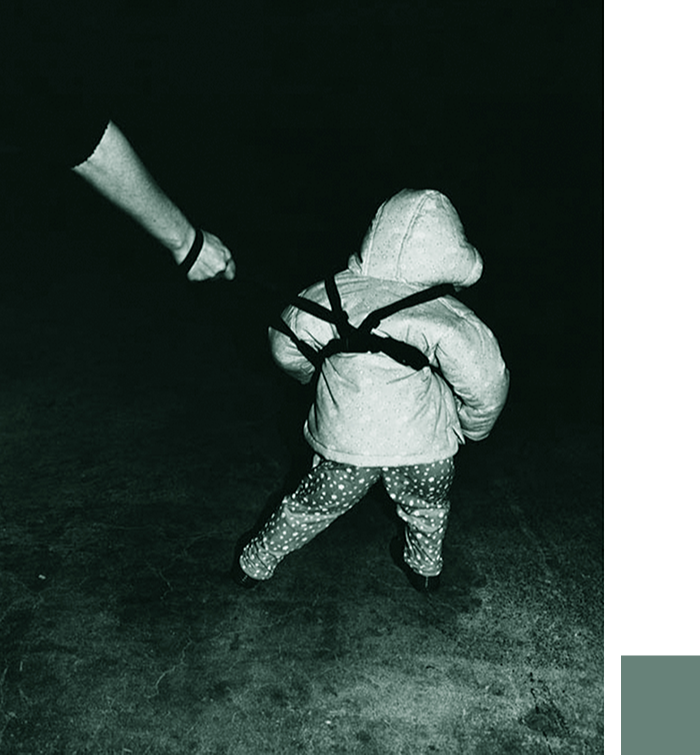
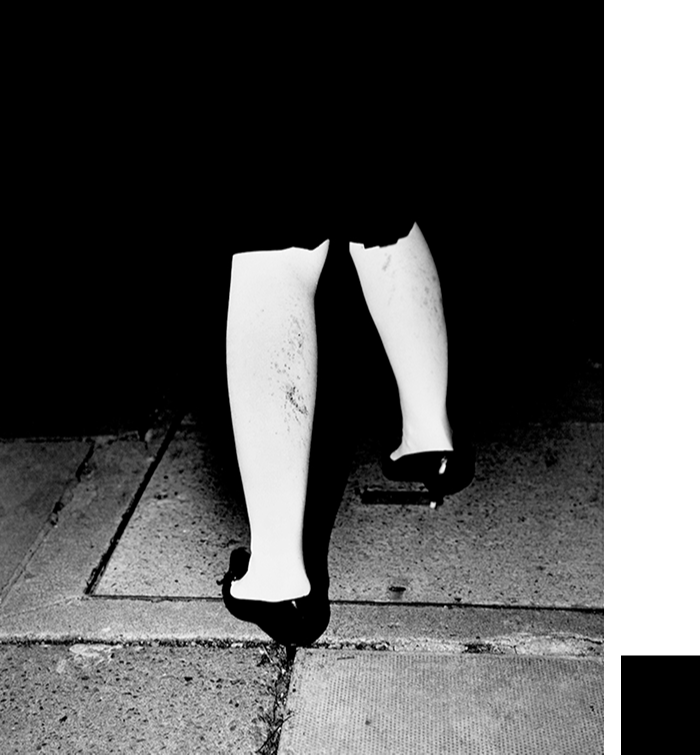
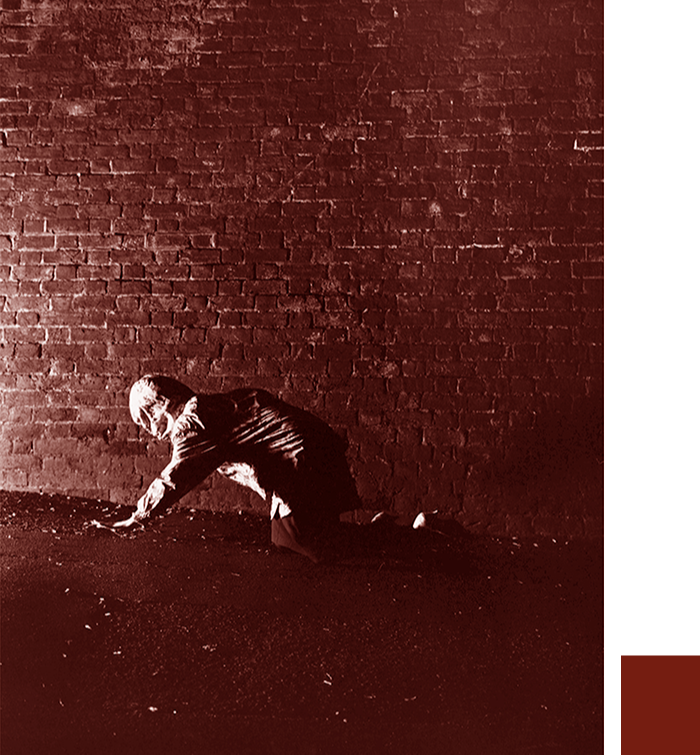
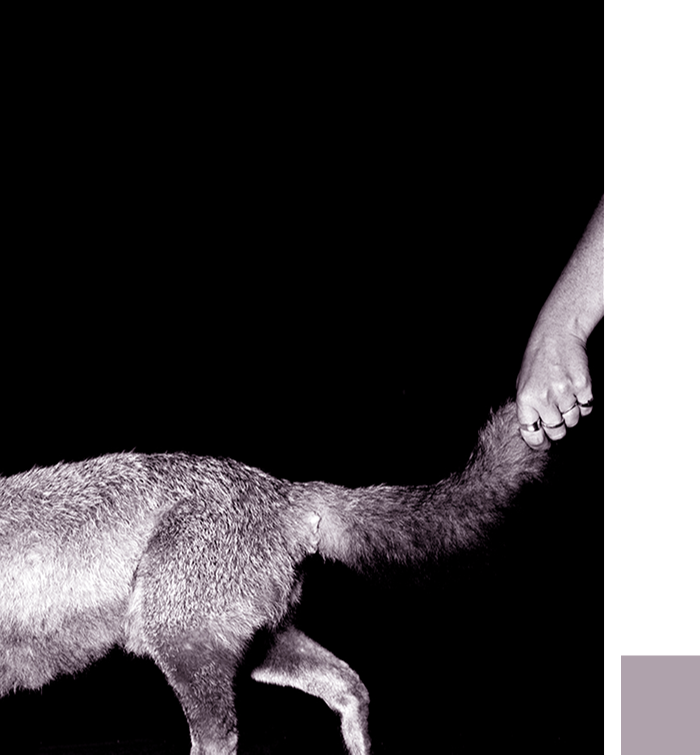
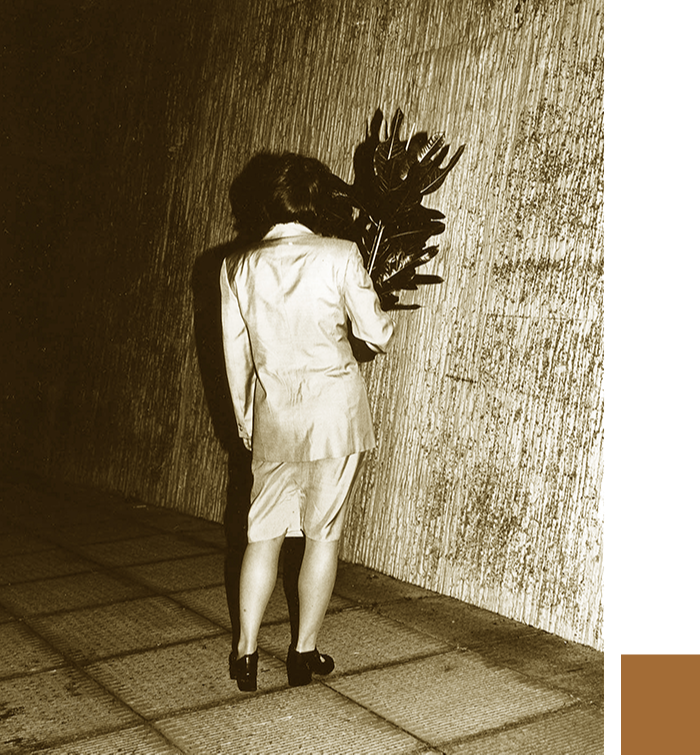
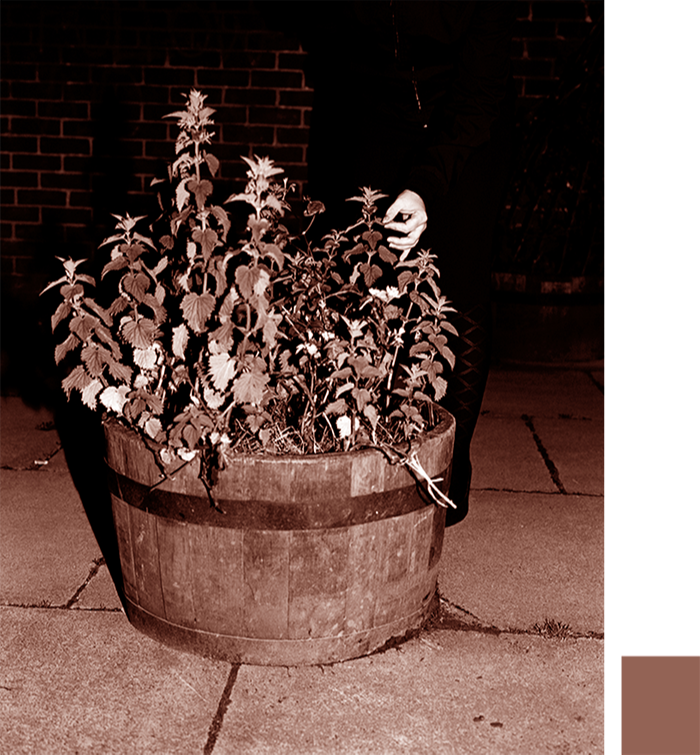
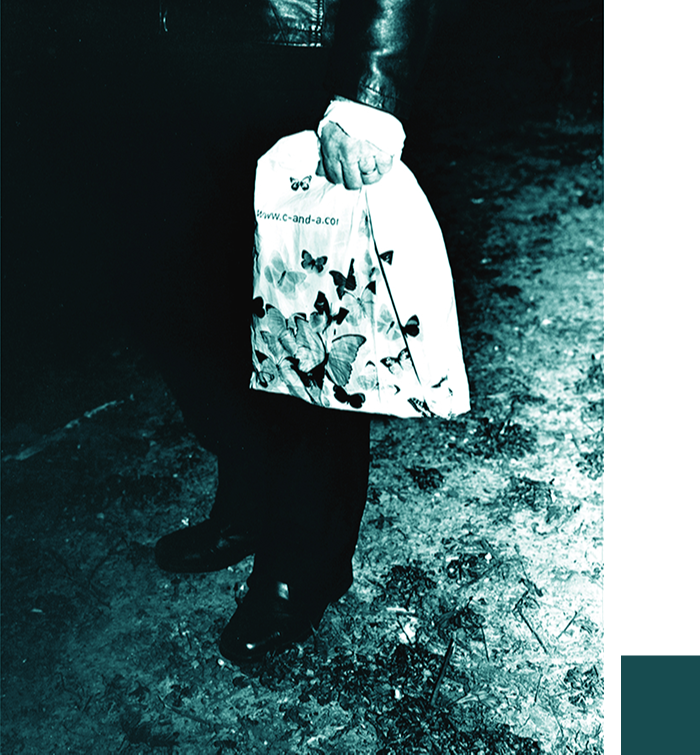
This facemask also took me back to the time when I had researched the Charles Booth Poverty Maps and Booth’s unflinching cartographic study of poverty in London. Between 1886 and 1903 booth surveyed the life and labour of the people in London, moving street to street interviewing the residence. The Booth study resulted in, amongst other things, colour-coded maps of London ranging from yellow to black, with blues, pinks and reds in-between. These colours represented the income and social positioning of the city’s inhabitants, from the lowest class, controversially categorised as the “Vicious, semi-criminal poor” to the less harshly judged “Upper-middle and upper classes. Wealthy.” The images shown here were all made in London, they tread a line between document and fiction. A heel stuck in a crack of the pavement, a man gripping a plastic butterfly bag and a toddler being reigned in by an adults hand. Each image has been toned a particular hue referencing the areas associated with the Boothian colour key. It is no news that London is a tale of two or more cities—a huge melting pot of the haves and the have-nots. However, over the past year or more these huge economic disparities have become even more apparent. London, like most cities, is a hard place to be poor and, conversely, a great place to be rich, with varying amounts of (dis)comfort in-between. Coming across this obscure use of the Booth poverty map was an unsettling reminder of the lack of real change in societal issues since these maps were originally drawn. As a Croydon girl, these are my thoughts on London.
Commissioned for FT Weekend as part of PhotoLondon special edition.
Philosopher’s Comment
The seven monochrome portraits in Clare Strand’s series for the Financial Times last year are toned according to the colour scheme used in Charles Booth’s London poverty maps of 1889. Each image is accompanied by one of Booth’s summary characterisations of the class composition of a neighbourhood. The pictures are taken out on the streets, presumably London—on the pavements in fact—and at a personal distance from their subjects. Though there are no faces, and the pictures do not display their subjects’ homes or their workplaces—the series is nonetheless replete with class signifiers, which are put in dialogue with the colour-scheme and with Booth’s nineteenth century phraseology.
Some of those class signifiers are in the clothing of the subjects; some in their jewellery; some in their relations to objects around them; to other people around them; to the space itself. More than anything, though, social class is presented in the portraits as something to be read through the bodily comportment of the subjects.
In a landmark essay of feminist philosophy, “Throwing Like a Girl: A Phenomenology of Feminine Bodily Comportment, Motility, and Spatiality”, Iris Marion Young sets out to describe and account for what she calls “modalities of feminine bodily existence for women situated in contemporary advanced industrial, urban, and commercial society” (Young, [1980] 2005, p. 31). Young provides an analysis of how certain ways of moving—ways of being in one’s body—are conditioned in women by patriarchal ideology and forms of life.
Clare Strand’s photos include a focus on such “gendered modalities of bodily existence”, but they ask a further, natural question: are there not also classed modalities of bodily existence? Consider, for instance, the contrast between two left hands. In “PINK. Fairly Comfortable. Good ordinary earnings’”, a woman holds the leaf of a stinging nettle between her thumb and forefinger, her other fingers curling out, her pinkie extended. Her hand echoes the delicacy and grace of the straight stems and symmetrical leaves of the nettles themselves. Things are different in “DARK BLUE. Very poor. Casual. Chronic want”, where an older man holds a plastic shopping bag. It looks cold—he’s in a wintery leather jacket—and the handholes of the carrier bag are wrapped over the back of his hand, leaving his fingers to clench the bag directly. This slightly unorthodox manner of holding the bag suggests that he has been holding it for a while, as though he’d been waiting in a queue, shifting the bag from one position to another to displace the discomfort, and using the handles to insulate even some small part of his skin from the cold. This is speculative. But the broader point remains: can you imagine a man from a PINK or YELLOW neighbourhood holding a carrier bag in quite the same way?
Above, I listed some of the dimensions of a person’s visible appearance through which their class identity is expressed. Lists like this can almost suggest that there are distinct mechanisms in each dimension: one story to explain why working-class people wear jewellery like this, and a separate story to explain their embodied relation to public space. Perhaps this is the right way to think about it. But Strand’s series, in foregrounding the confluence of this range of class-determined characteristics, raises the question of whether there is a more unified story to be told about the expression of class identity.
-
PHOTOGRAPHER
I am British artist, working with and against the photographic medium. Over the past two decades I have worked with found imagery, kinetic machinery, web programmes, fairground attractions and most recently, large scale paintings. I often reject the subject-based qualities and the immediate demand of information, so often associated with the photographic image and instead, and without apology, adopt and welcome a subtle, slow burn approach.
I have widely exhibited in venues such as The Museum Folkwang; The Center Pompidou; Tate Britain; Salzburg Museum of Modern Art and the Victoria and Albert Museum. My work is held in the collections of MOMA; SFMoma; The V&A; The Center Pompidou; The British Council; McEvoy Collection; The Arts Council; The NY Public Library; The Uni Credit Bank; The Mead Museum and Cornell University.
I have produced 3 publications, Clare Strand Monograph published by Steidl (2009), Skirts published by GOST (2014) and Girl Plays with Snake published by MACK (2017). I am represented by Parrotta Contemporary Art, Cologne/Bonn.
I’m also one half of the collaborative partnership MacDonaldStrand and Head of the Intangiable for The Institute of Unnecessary Research.
clarestrand.co.uk -
PHILOSHOPHER
I am a Leverhulme Early Career Fellow at the University of Birmingham. My philosophical interests are generally connected to interpersonal relations, particularly the ways that people matter to one another. At the moment I am pursuing a project about the aesthetic dimension of interpersonal life. You can read a summary of that project here, or listen to a podcast on which I recently discussed some of the project here.
A workshop organised as part of the project will be held in Birmingham in June 2022. All the information about the workshop, including the Call for Abstracts, can be found here.
I completed my PhD at the University of Sheffield 2015–2019. My dissertation was supervised by Robert Stern and Paul Faulkner, and is called “The practical significance of the second-person relation”.
With this theme of interpersonal relations at the centre, there are a range of areas of philosophy that I am interested in. They include metaethics (especially theories of practical reasoning, and moral epistemology), philosophy of love and friendship, the connections between ethics and aesthetics, and several historical figures, most prominently: Martin Buber, Simone Weil, Emmanuel Levinas and J.G. Fichte.
jameshplewis.com
Interviews
Long-form interviews and discussions, designed to work in units. Both formats offer the same entry: into the artist's mental atelier. Not to observe from a distance, but to learn from the inside. Philosophical insight here emerges from the conversation itself.
Interviews: Spiros Hadjidjanos – Alexandra Athanasiadou
Spiros Hadjidjanos, Where are the people that talk on the radio?, 2008
Visit Kaput online art journal to read Refractions of Information Revealed, an interview with visual artist Spiros Hadjidjanos.
-
VISUAL ARTIST
Spiros Hadjidjanos (born 1978) is a Greek visual artist who lives and works in Berlin. Hadjidjanos studied with a DAAD scholarship at the Berlin University of the Arts (UdK) where he was awarded the Meisterschülerpreis des Präsidenten. Currently, he is a researcher at the Royal Academy of Fine Arts in Antwerp. His practice spans across different media and is informed by his critical reflection on technological processes and his personal biography. Since the beginning of his artistic practice, he has explored computational images by technological means, primarily referencing the transformation from photographic record to data points with works that traverse spatial, temporal, calculable, and material dimensions. He has created set-design for theaters such as the Volksbühne in Berlin and Kammerspiele in Munich and has exhibited his work in galleries and institutions such as the Yerba Buena Center for The Arts in San Francisco, KW Institute for Contemporary Art in Berlin, Städel Museum in Frankfurt, Musée d’Art Moderne and Palais de Tokyo in Paris and K20 Düsseldorf.
spiroshadjidjanos.net -
PHLSPH
Dr Alexandra Athanasiadou works at the intersection of visual practice and philosophical inquiry. She is the founder of the PHLSPH Lab: Image Thinking Lab.
For fifteen years, she has worked with images—inside museums, galleries, and universities, but never quite contained by any of them. Her route through the photography world has taken her from the Museum of Photography in Thessaloniki to Candlestar in London, from European platforms like Transeurope PhotoProject to curating and setting up a photography award with IOM Central Asia, from a research program at the University of Crete to her current roles as a Special Scientist at the Technological University of Cyprus, an external tutor on the MA Photography and Society at the Royal Academy of the Arts in The Hague, and a teaching position at the School of Visual and Applied Arts, Aristotle University of Thessaloniki.
Along the way, she built something between the usual categories: a practice that draws on academic training (a PhD in Aesthetics; the Courtauld; Oxford; Panteion University) but refuses to stay in its lane. The work sits at the edges—close enough to both the art world and the academy to know their rules, far enough in to move freely between them.
Interviews: KABK Students – PHLSPH
In the spring of 2024 the MA students of the Masters of Photography and Society took a field trip in Thessaloniki, in Northern Greece. Presented here are most of the projects that they created and produced in less than a week. The artists worked in different configurations (groups, duos, under a common project theme but with separate works) while two artists were assigned to operate as curators. Their work was presented in the pop-up exhibition “Fragments in Transit” at Beetroot Design House for a day. Here you will find an exchange of views in regards to their work, in an attempt to keep the images travelling outside the city walls and beyond the time frame of the exhibition.
Karin Van de Wiel, Marna Slappendel
-
ARTISTS: Karin Van de Wiel, Marna Slappendel
Resilience in Every Direction visually examines the interplay of order and disorder within urban settings. By following the paths of activist protests from earlier this month in Thessaloniki, it ponders the remnants left behind mere days later, as life resumes its usual rhythm.
As a protest unfolds, individuals engage in various forms of resistance. Some take to the streets, while others strategize at the table in their living rooms. Books are penned, workshops organized, silent donations made, and some challenge the system with subtle acts in public spaces. The project Stones & Cones by Karin looks at different multitudes of protest.
With the project The Stance Marna looks at the realm where unfairness is felt. How do you choose a stance? Do you radically rise and raise your voice, or does silence guide your path? Perhaps, amidst uncertainties, you linger in between.
[Exhibition text by the artists]
PHLSPH: If I were to make a diagrammatic image of your project I would see the stone in the centre and then rings around it, the undulations of a gesture or from constellations of gestures, political events to be more precise, which took place before you arrived in the city. Would this resonate with your practice?
Karin: Although the project started with thinking about the cones as little, silent plastic soldiers we obey, and graffiti as a mode of resistance, it turned out that the stone became the key image. The centre of the project. Maybe it’s because I took it out of its surroundings and isolated it. I placed it delicately on a soft pillow. It ended up receiving more attention from me than the cone, which I left where I found it. A 24-hour strike occurred a year post the nation’s deadliest train crash. Firebombs hit riot police, tractors dumped chestnuts to protest production costs. Students oppose a bill on private universities. There is a forensic dimension to the stone, and the other objects circling around it; the clues and the bits of material left behind from a moment, and how these tell the stories.
PHLSPH: If I were to make another diagrammatic image I would see that the objects you have chosen incite the extension of time, they work as props for mental images and as residues of actual facts. Are you interested in the “lanes” created or the lines depicted, as it were?
Karin: The physicality of the political events that took place before I arrived, they are places for me on a map. Mapping through movement. The objects (residues, traces) found at those locations become the mental images for those events, and they endure in time—as you call them “extensions of time”. The traces of the events at those physical locations and places almost didn’t exist anymore in the physical world when I looked for them. I can imagine now there is nothing left anymore. Can we say that these objects carry the narrative of the political events that took place? So that we remember?
I do see the objects as a network of resilience. They all together draw a line of resistance in the city, and resembling the time (different days, hours of the day and duration of the protests) the events took place. At the same time it also reflects on the future: the same objects will most likely be left behind. It will be a different stone, but its function and meaning is the same.
PHSLPH: Do you think that sometimes the line between cones and stones, metaphorically speaking, is blurry? And under some circumstances maintaining the cones or trying to find ways to shift them may be as powerful as using stones? And that stones lose their power and become cones, as it were?
Karin: There is a blurred line between the cones and the stones. You could look at it that what for someone is a stone, can be a cone for someone else. Or as you mention yourself: a stone can lose its power (by what/whom?) and it becomes a cone. Can a cone be as powerful as a stone? Depends on the goal; so I’d say yes. Maybe a stone can physically destroy more, but does that not make it more powerful but just a different “tool”? Why do we think a stone is per definite more powerful than a cone? So maybe it is better to speak of different “uses”? And not that one is more powerful than the other?
Marna: To me, the cone symbolizes a kind of gentle way to deny access. But, of course, only in relation to humans. Despite the fact that it is made of soft, compressible material and you cannot literally bash someone’s brains in with it like you can with a stone, the material it is made of is indeed deadly for the environment. So if you look at it in a literal way (from a non-human perspective), it suddenly takes on a completely different, much more aggressive meaning.
If I were to apply your shifting cone to stone idea metaphorically to my work The Stance, I do see comparisons between the shifting and the “lingering in between” phases. The phase of contemplation, hopefully without the pressure of others, can lead to a radical change of opinion, transforming a cone into a stone. Or vice versa.
PHLSPH: And in the same light if I were to look at Marna’s project, as they were coupled, I see it as an exploration of the space in between the undulations, the flexible movements happening in between. Marna, how flexible is time for you?
Marna: When someone is truly focused on either contemplating or working on something, time does not play a role at all anymore. It seems absent, or, as you might call it, “flexible”. This work aims to emphasize such a moment, the “in-between” phase. A timeless moment of concentration, truly considering all things involved in taking a stance. Is it even possible to know all the things involved? Do you have to take a stance? Does doing nothing also mean taking a stance, and is it okay not to know and linger in between? Nowadays, with the growing polarization and the strong black and white opinions, I like to shed light on the gray areas and the doubts.
PHLSPH: Marna, your project is very political and at the same time atemporal. I see this choreography of ambivalence in taking a stance also as move of slowing down to process the information with which we are bombarded. We are so often dictated to take a stance in an absolute and very speedy way. Is this project also about reflection?
Marna: My inspiration for the work was the protests in Thessaloniki, but ultimately the work is about something else, something universal that speaks to everybody. About responding to feelings of unfairness in situations that everyone deals with every day. And taking the responsibility of thinking before acting. Even though I am not raised religious, I like the biblical connotation shown in this work Who is without sin, be the first to throw the stone.
Joseph Kennel, Niside Panebianco
Joseph Kennel, Niside Panebianco
-
ARTISTS: Joseph Kennel, Niside Panebianco
Looking to the western limits of Thessoliniki one is faced with an active boundary, a stark break between city and non-city. Physically reaching this border, the highway cuts through the landscape, forcing us to turn our gaze and our steps back towards the city. At the core of Thessaloniki another boundary inhabits the urban fabric, the Byzantine walls that fluidly cut through its different layers.
Sensing the western line of this wall, the details of its material composition and the surrounding cityscape provide a collapse of temporal scales. As a skeleton, the wall sustains, penetrates and confines a shapeshifting urban environment that tightly hugs its structure. Walking the western line of the wall, we began to engage with it not only through our gaze, but also with our touch in an attempt to feel the wall’s material presence.
When considering the wall as an infrastructural constant, it transcends its physicality becoming a representation of time itself. Its cracks and openings act as a portal to the past and a frame for the present. Flowing through the buildings and parks that surround it, an old border becomes absorbed by the city, no longer being able to divide.
[Exhibition text by the artists]
PHSLPH: Would you agree that what was encountered first as the skeleton of the city, as you described it in your text, could also now be seen as some of its veins, pumping the city with memories and histories? What would you say is the relationship between stones and ruins in your project?
Joe-Niside: From the ruins of the wall new possibilities and ways of thinking through the city’s identity are possible. The wall stops being merely a ruin when it is taken as part of a larger continuum of the urban history of Thessaloniki. Both the stones and the ruins are the constitutive elements of the contemporary urban fabric of the city, and they exist in a dialogue that articulates in every corner, square and neighborhood of the city. In this way we were not thinking of the wall as ruins per se, but rather an important infrastructural element of the city, another set of stones as opposed to the more recent buildings around it. A set of stones that are merely older but that constitute the same urban fabric we were walking. At the same time, they set the rules of accessibility with gateways and portals having been turned over time into roads and walkways. Because of this observation, the wall felt to us as a temporal constant in the urban history—and identity—of Thessaloniki.
PHLSPH: What led you into making a charcoal drawing of their materiality?
Joe-Niside: After extensive walks along the infrastructural barriers we encountered in the city, first the highway, then the old city walls, we felt we were walking in parallel with very concrete lines existing in the city but not actually interacting with them. The pace of our steps was allowing us to sense the landscape and urbanscape but not the wall alone. The charcoal prints became a strategy to record an unfiltered impression of the ubiquitous architectural element. It then also became a means for bringing the walls and a sense of temporality into the exhibition space. This feeling of time in the drawings is reflected in the textures of the stones; textures that hold the marks of many historical moments and the slow passing of time that has weathered them. The very texture and burnt like color of the transfers is also significant as an echo of the history of the Great Thessaloniki fire of 1917. In this format the transferring of materiality becomes a metaphor for all the historial layers that are encapsulated in the wall.
PHLSPH: In many of your images the walls are in direct contact with nature, juxtaposing different temporal scales.
Joe-Niside: For us documenting this juxtaposition was an important part of our process as we feel it is an embodiment of sensing or feeling in the images of different temporal scales present with the city. Partly we see the image as a means of placing these temporalities in relation, one that is human and linear as represented in the different era’s of architectural development. The other being a more fluid circular and non-linear representation of time, the plants and soil surrounding the wall, and juxtaposed throughout the city. Documenting how nature and the wall collided and melded becomes for us an important conceptual means of thinking about how a space can hold many temporalities, many histories, non-human and human within the forms that are visible. In this sense the images are in some ways a proposition for our viewers to consider how different timescales, exist within any urban space, and tuning into these temporalities might help up better understand how urban environments are not bound to linear development but rather the past and the present exist simultaneously in the forms that we walk amongst today.
Sarah-Rose Antoun, Aline Papenheim
Sarah-Rose Antoun, Aline Papenheim
-
ARTISTS: Sarah-Rose Antoun, Aline Papenheim
We arrived in Thessaloniki with a Polaroid camera with the aim to discover the city from the perspectives of both a photography student and a tourist. In approaching the Greek men and kindly asking them for a picture, we found overlapping interests in this gesture: personal stories relating to a place and memory, masculinity and stereotypes. Curiosity about the responses of the photographed men and what they might do with the received image triggered us to take not one but two photographs, both of which will be kept for individual reasons.
Our gaze, influenced by a stereotypical expectation of the city and its inhabitants, Greek men in particular, guided us to three locations: the Kapani market, the seaside promenade, and the University of Aristotle. We documented almost every encounter, capturing not only the conversations but also the unspoken moments in an audio format. The use of “missing” images serves as a reflective text, allowing for interpretation on what’s absent and responding to our emotional experiences.
[Exhibition text by the artists]
PHLSPH: By using polaroids and creating this “play” of also offering them to every person you photographed, the project opens up to different directions: extending the space between the two, co-creating, operating as a trace of an experience and not just of a moment among others. What were the most important effects of this “play” for you?
Sarah-Aline: This idea is an extension of one of our modules from the first year of the master’s degree studio II: relational photography, which was meant as an invitation to collaborate with someone through the photographic medium while losing control. Adopting this collaboration method, we created a concept with a “gesture” of taking and giving back at its heart: to take one of the two taken polaroids to display and tell the individual story, offered in a matter of physicality within the medium of the polaroid. Observing how the recipient of the object-polaroid would react to this “gesture” was the most memorable part of the “play”—one significant example is the policemen we met on our way to the sea promenade. Following a conversation about his favourite parts along the seaside, or even to describe to us his attachment to Thessaloniki, we came to ask if he would agree to be part of our project when we gave him the Polaroid, he asked us how much he owed us—as funny as it sounded for us that ‘naive’ question was a drastic power ‘play’ between the masculinity of such role of being a policeman, and “responsibility” that it also implies. The first person that we took a picture with, who told us later that he wanted to keep the picture when he kissed me on the cheek to show his wife, as a trophy symbol—this play of observation but also imagination, what would the photographed person do with the image? The play served as a stage for us to engage with strangers, creating a situation where both we and the men we photographed were placed in vulnerable positions. This setup sparked curiosity about what would happen and how they would react. By reflecting on the situation and documenting it with Polaroid photos, we were able to discuss the various layers of what occurred.
PHLSPH: In your general text, you start by saying that you came to the city as tourists and photography students and then in one of your explanatory smaller texts you mention the “tourists” at the pier. Did this “play” in such a condensed time allow you to explore different terrains, and distance you after a while from being tourists or was the choice of words just a slip of the tongue, as it were? Are perhaps those encounters, offerings and exchanges one of the few ways of escaping one’s “tourist gaze”—if ever possible?
Sarah-Aline: We’ve played around with the notion of “situatedness”, first observing, imagining and then situating ourselves within the city and its different realities while being aware and transparent about having the gazes as tourists, fully embodied by the fact that we’ve discovered Thessaloniki for the first time while on the field trip. The given circumstances we navigated around at the time, a short period to pitch a project, to go on and about with its production, and finalisation with a pop-up exhibition as a conclusion became stages that we’ve also explored within our experience as tourists, first the dreamy bubble, that is reflected with the first three polaroids and its “pink” veil, made possible as the polaroid sheets travelled through the airport x-ray, and choosing to play with that: observing, as we choose three locations to work from for this project, and the rush to produce which made the “tourist” experience less traditional in that sense, as we’ve shifted toward a more “professional” approach, a business stay as might call some corporate industries. The conversation shared with us, intimate sometimes, about realities in the city opened up a new window to this “touristic” experience—for instance, when Christos from Bezesteni Ottoman the market shared with us the complexities of running such a “traditional” typer letterpress business in Thessaloniki, he told us about the unstable parameters of his everyday life, but also in his own words describing the city he knew from a very early age. Listening to Christos, give us a comprehensive understanding of his routine.
PHLSPH: Is there an emotional experience in one of your “missing” images you would like to share or has now, after some time, settled in and would be visible?
Sarah-Aline: One encounter that stayed with us was with the fisherman Illyas whom we met at the end of our project, sitting with his bike and plastic bag meagre from his catch of the day—the honesty and the time he took to answer our questions was a precious moment for us.
It was special because he was the only person we photographed who stayed in the same position, uninterrupted with his task when we encountered him. Maybe he used the missing picture we gave him to impress a woman; that’s what he told us he wanted to do. Perhaps he kept it with him during his daily fishing evenings, putting it into his sack next to the plastic bags tied to his bike as he cycled home late in the evening, through the sea promenade, where tourists were heading back to their hotels. We did appreciate his honesty.
We have had situations where a man kept an image with our faces next to his. Today, we sometimes wonder what they did with them. Do they keep it in some box, is it hanging on a wall or a fridge? Maybe they think about our encounter when they look at their polaroid (if they still have it), and maybe they wonder what we are doing with the objects with their faces that we kept. In that sense, the communication continues between thoughts and speculations that we project onto the polaroid we kept, which connects to the missing one.
Andong Zhengand, Fabio Meinardi
-
ARTISTS: Andong Zhengand, Fabio Meinardi
In the contemporary landscape of social media, tourists encounter new cities with a myriad of distractions vying for their attention. What captivates their gaze, prompting them to reach for their smartphones, capturing and sharing images with friends, family, and broadcasting them across social platforms? What images can transcend the surface of the city, becoming cherished souvenirs of their experiences?
Thessalonikat endeavors to grapple with these inquiries, engaging in a critical examination of smartphone photography, meme aesthetics, and the significance of circulated images as souvenirs. Through a critical lens, Andong and Fabio examines the role of postcards—a tangible symbol of tourism memorabilia—in shaping our memories of a place. Thessalonikat challenges the prevailing notion of mass-produced souvenirs that often oversimplify our connection to a location. Each postcard crafted in Thessalonikat stands as a unique testament to the essence of the city, capturing its soul through the lens of its unseen feline inhabitants.
[Exhibition text by the artists]
PHLSPH: Cats are one of the most circulated images on social media. What happens when you keep the same theme but change its mode of circulation by printing unique postcards?
Fabio-Andong: First and foremost, the mode of dissemination of these cat photos shifts from algorithm-based radial broadcasting to a point-to-point mode. In this scenario, the propagation of the images becomes more directional and intimate (although in this context, the difference between postcards and letters lies in the fact that they are not entirely private—anyone in the postal infrastructure can access these photos and the information behind them). As a result, we no longer feel like shouting into a blurry void but must instead select a recipient and write specific messages to them on the back of the postcard. Additionally, it takes effort to have a photograph printed out and exist in the physical world. It requires effort to fold, carry, mail, and even destroy it. In this form of existence, the photograph carries more weight.
PHLSPH: Could Thessalonikat operate as a counter narrative to what we choose to photograph and share as a cherished memory of the places we visit?
Andong-Fabio: Yes, Thessalonikat relies on various counter-narrative strategies and nods to the practice of smartphone photography. The concept of souvenirs, and more specifically, postcards, just like the images captured with these portable devices, are “visual” memories that we often use either to communicate to someone that we have been in a certain place or to bring home a “piece” of the place’s magic, feeding archives that are rarely consulted afterward (just like folders on our phones). Usually, these souvenirs depict the mass-reproduced symbol of the city, be it a monument, an architectural work, or something else. Thessalonikat, on the other hand, aims to represent, with the typical naivety of tourists, the silent but widely present inhabitants on the streets.
PHLSPH: Do you feel that sometimes the art world is over intellectualizing the act of image making and in that sense instead of empowering the artist actually making him/her more restrained and detached from his/her experience?
Fabio-Andong: As we began this project, we were mindful of the fact that our trip to Thessaloniki was embedded in an institutional structure and agenda. While we’re cautious about generalizing this to “the art world,” we do see the art academy as an integral part of the artistic landscape. Each educational program has its own focus and discourse, and we’re aware that these discourses represent a unique voice within a broader context. In our day-to-day practice, we often find ourselves grappling with the need to intellectualize and conceptualize our work. However, as artists, it’s difficult for us to generalize whether a conceptual framework is “over-intellectualizing” or not from the perspective of different specific audiences.
Therefore, we do not view our actions as a direct resistance against “an over-intellectualizing tendency”. As we mentioned in the previous response, we are aware of our own superficiality and naivety when initially exploring a new city as tourists. We particularly strive to be honest about our naivety, as it is a universal quality shared by all tourists and can thus serve as a point of connection among people.
-
ARTISTS: Ana Alves Francisco, Anastasia Miseyko, Benjamin Morrison, Roger Anis [group project]
This place was once a tower, a home, a garden. Now it is a square.
It remembers the comings and goings of peoples, from Turks, to Slavs, to Jews and Greeks. Time has washed away the stains, yet traces linger still. In the burst of pigeon flight, to the slow slink of the ginger cat. Amongst the blues and reds of the scrawling graffiti and in the scarred bark of the two trees. It rests on the hands and faces of the people that sit in the shade of the byzantine wall.
A central stage for small acts, the square invited us to sit and watch the shadows grow. What can be found in absence? Can dormant seeds bloom? From the physical act of placing a seed in the soil to the chance encounter of two like-minded strangers, we document these encounters. Through this artistic intervention, we have seen the ghosts of the city, hiding in the quiet whispers of the walls.
[Exhibition text by the artists]
PHLSPH: When did the place transfigure into space? How did this come about and how did that facilitate you into seeing the square as a stage?
Ana-Anastasya-Ben-Roger: As a group, we sat together trying to figure out what we could do and wanting to learn more about the city. We listened to a long voice note from a friend, summarizing the book City of Ghosts by Mark Mazower. The voice note lasted for seven minutes, and we all listened while sitting on one of the benches in the square, looking at the old walls surrounding us. People were passing by, meeting at the intersection of the square, and entering and exiting the square as if they were entering a new time, new area, and new space. Doves were also coming and going, flying in and out of the square. They were waiting for those who came every day to feed them, while more people entered the square from all different classes, each person in their own world.
As we listened to the voice note about how the city changes, we contemplated what we just heard and silently found the answer to our story. The square was the answer. It was the pot for the changes that happened in the city, a pot for the different people coming and going and inhabiting it. After sharing this idea together, the square became our pilgrimage every day and our meeting point, sometimes more than three times a day. We met on its benches to observe, discuss, unfold, and present what we had discovered.
A place transforms into a living canvas when you choose to embrace it. As you linger, observing its subtle dances and quiet whispers, it blossoms into a stage. Here, you witness life’s actors enter and exit, perhaps even finding yourself part of the performance, or contentedly watching the rehearsals unfold. Everywhere, space awaits, but place is where your attention goes. And there’s nothing as valuable as our attention.
PHLSPH: The project directs the viewer inside and outside of the image. The image seems to be the seed from which the dormant stories bloomed. Was that the case? Which stories were activated because of the image and with the image?
Ana-Anastasya-Ben-Roger: We believe that it was not just the image that triggered the dormant stories. Instead, it was a combination of several factors such as the soundscape, the voice note, the pictures of the old city, the graffiti on the wall facing the old wall, the contrasting images and people that we kept seeing flowing into and out of the square, as well as our discussions and arguments. All of these elements together activated the stories and images, and we began to view the square in a different light.
We believe the seeds of our actions were sown long before we planted them in the soil. Thus, our efforts served as both a metaphorical manifestation and a reenactment of the latent seeds—the memories, the symbols—that already resided within the space we chose to engage with. Our endeavor merely unveiled and nourished the potential for blossoming flowers.
PHLSHP: What happens when ghosts live among us? Does it weigh us down or does it have another effect?
Ana-Anastasya-Ben-Roger: Ghosts! Ghosts are a part of our history and their presence can either weigh us down or inspire us. We have the power to choose how we perceive them. Ghosts can be more of a blessing than a curse as they remind us of the past, which we can learn from and look forward to the future. They can protect us by witnessing events and reminding us of what has happened. we should not fear ghosts but instead embrace their existence as a way to preserve history and move forward.
Every corner holds echoes of the past, lingering like gentle specters. We, too, are but spectral figures, destined to leave our imprint upon the spaces we inhabit, even after our earthly departure. This does not necessarily mean that these ghostly presences weigh down the existence of the living, but should nevertheless not be forgotten. In remembering, history takes central stage, and its legacy is revered and honored.
-
Artists: Tina Chulo, Hana Selena Sokolovic
Coming from the Balkans, we both immigrated to Western Europe for a “better life”, like many other people from the Balkans peninsula. We wanted to explore how the young people of Thessaloniki feel about leaving their country, the ones that left, and the prospects of staying here. A common thread seems to be seemingly unsurmountable economic and political difficulties that aren’t leaving much space for growth and life that many of us dream of. Despite this, there is a shared appreciation for the warmth of people, strong community, and warm climate, which many will miss once they leave. We agreed that people here are generous and loving, and interactions are often shared with food around the dining table. With this work, we wanted to create an echo of feelings that seemed to linger among many of us.
[Exhibition text by the artists]
PHLSPH: The “brain drain” has been a recurring issue in the public conversations in Greece. Yourprojectwith its cinematic qualities achieves to depict with a very specific gesture, an abstract idea. Howdid this metaphor of the chairs around the dining table, taken away one by one, come about?
Hana-Tina: Love shared over a meal is quite present in the Balkans and Mediterranean. The family house’s most important place is a dining table, as sharing love is tightly connected to sharing food. We often joke about how our grandmothers and mothers cook too much food and that you kind of need to eat a lot to show them love back. There is really no way to get up from the table without stuffing yourself, especially during the holidays. Nowadays, it is only then that we come home, and this becomes that one moment that the large family table shines again, as all members of the family are present. We both receive photos from our parents later, showing how the house feels empty, and it is often a photo of them having lunch alone. From this reflection, we started to perceive the family table as a symbol of unity and togetherness. With so many young people moving, the tables that once couldn’t even fit everyone are now becoming too large, leaving only the elders. The removal of chairs symbolises the young immigrant generations and the loneliness of the older generations, who stay behind and eat alone on the furniture that was initially bought to welcome many people. So, context and costumes haven’t changed, but a number of people have.
PHLSPH: Do you think that political pieces like “The Return is but a distant dream” enclosed in apoeticanalogy brings about more awareness?
Hana-Tina: We wanted to bypass the crudeness of facts and allow for a larger emotional comprehension of the current situation. There is a discrepancy between how people feel and what they see in the media. The information presented is often expressed through statistics, lacking emotional and related aspects. We hear vain promises about changing the economic situation or sad statistics about how people have already left and how regions are deserted due to heavy immigration. But we rarely hear how people feel about it and how a community can work together to change those aspects. There is a variety of sentiments towards the topic. We wanted to encourage emotional responses towards the issues by using a poetic title that can be read and understood differently depending on the person reading it. The sense of ‘the return’ is interpreted differently by the ones who leave and stay, and there is no right answer, just a variety of human experiences.
There is a sense of longing to return to a place we once knew, maybe experientially, maybe only through our imagination. Returning to the innocence of childhood to a biblical Eden is a deep-seated longing of humanity, and it seems that immigration further emphasises that feeling. We ascribe many meanings to this return, but sadly, it feels out of reach. Even if people physically return, it is still just a dream as one never returns to what was left behind since places and people evolve, and there is no coming back to what once was or who we once were.
PHLSPH: How important was it to have people living in the city as your co-creators in a way, having used their thoughts and concerns as the core of the project?
Hana-Tina: We wanted to approach the topic from an emotional point of view to make people feel heard and seen. We talked to young people from Thessaloniki to give their voices a safe space to express emotions without judgment. The idea came to create a chamber where voices from the collective consciousness are expressed and no longer just linger in the air but rather are embodied around us. Voices that are acknowledged and heard. The echoing of the voices allowed us to become aware of the emotions that are present among young people. Many people who have seen the work approached us by saying they felt seen and heard by watching the work. It was very touching to hear that they could relate to many or to some voices that were present. So, it was very important to collaborate with people from the city to embody and shape the true sentiment that exists among them.
Azin Nafar Haghighi
Azin Nafar Haghighi
-
ARTIST: Azin Nafar Haghighi
“A port is a palimpsest, the city’s skin. It is the sorrow of the city and the city’s hope.”
— Berger, John. “G.” Vintage International, 2016.
Since landing in Thessaloniki, I’ve been contemplating whether leaving is harder than returning. Through personal experience, I’ve glimpsed a story out of millions in this city. Sometimes, one chooses to return, even after being pushed out by society or when society simply doesn’t care about one’s presence. I wonder about the importance of solidarity in society. Would everything have unfolded differently if there had been solidarity? Can what is now labeled as solidarity truly prevent anything? Then, my thoughts turn to the port here in the city, where I observe people departing in solitude and arriving to confront what they have left behind.[Exhibition text by the artists]
PHLSPH: In Adio Kerida you use visual, textual and musical poetic language. There is also a translation of the literary text in Farsi. Poetry is one of the most direct ways to grasp a truth, but is there also an underlying political gesture here?
Azin: As much as I know and have read about the history of my country Iran, poems truly came into existence to discuss the forbidden and what was banned to talk about. That is the function of metaphor for us Middle Easterners as well. I can say we really don’t speak about it; we speak around it.
PHSLPH: In your text you refer to solidarity and you wonder if the course of events would have been different had it been expressed during the annihilation of the Jewish community. This is a very astute comment about the history of Thessaloniki, something that we hadn’t had the courage even to utter let alone discuss some decades ago. In hindsight, the course of history most probably wouldn’t have changed, but a strong mark would have been made. In that light, the project apart from being historical and political, may also be existential in a sense. Does solidarity seem Sisyphian at times?
Azin: First of all, as an outsider, I do not allow myself to talk or judge the history of Greece, and specifically Thessaloniki. I can only talk about my feelings and what I have understood there in just a week. But generally, for me, solidarity can be considered a matter of consistency, much like Sisyphean. You cannot carry a different stone every time just because of popularity. It needs time and patience; otherwise, it’s just a word said out loud without any audience.
PHSLPH: How does the project touch upon the trauma of return?
Azin: I can only refer to my own experiences in life and how we cannot simply decide to go back to our same society because it’s our comfort zone. In this project, my only goal was to convey the feeling of being a survivor even on a really small scale. We all know about history and how numbers are fetishized, but what we cannot touch and relate to are the feelings. What is trauma? Can we relate to it without experiencing one?
-
Here are some thoughts and images that artist Gundega Strauberga shared regarding her experience of the city, this time from the role of the curator.
PHLSPH: For this project you had to operate as curators. But let’s imagine we are here offering the space for your own artistic project stemming from your experience from the city of Thessaloniki. What would that be?
Gundega: Before the intense production days, during one of our first days in Thessaloniki, I took a walk in the upper town along the city walls, going up and down the hills overlooking the sea. I had brought with me 2 rolls of film which I had the intention to fill up before heading home. I suppose what came out was my personal mini project which had to be completed within those 3–4 hours. So I ended up walking along these roughly 4-kilometer-long Byzantine walls, once a fortification and a border; now merely a Unesco heritage site which gets swallowed up by the surrounding buildings, infrastructure and daily life rhythms of the people inhabiting both sides of the wall, almost as if ignoring its presence.
On our last day in the city I stumbled upon a street market. There were boxes upon boxes of old photographs and postcards from Thessaloniki as well as the surrounding areas. Spotting these kinds of relics has always been my weakness; the boxes contained mass-produced vintage postcards for tourists, but also quite intimate family photographs from someone’s personal archives. Did they belong to the person who was selling the images? Or did he obtain the images from elsewhere? The careless “10-for-the-price-of-6” attitude of the seller did not sit well with the intimate and authentic nature of the photographs on sale. I bought a couple of postcards and photographs which I later compared to the ones I had taken with my camera. Some of them had a striking resemblance … Recently I’ve been interested in the idea of “cameraless” or “borrowed” photography. Picking out certain photographs from a pile, is, too, a form of curating, which affords the creation of a multitude of stories. If I were to create a project during this trip, or perhaps only if I had found that market sooner, I would have enjoyed working with the images I’d find in those boxes on the street. In this way I would like the city of Thessaloniki to show itself to me, alternatively to me framing it.
PHLSPH: Do you feel that the curator’s work is overrated or underrated by visual artists? Why is that so?
Gundega: For sure curating is a job as creative as making a project as an artist. Within the field trip, I believe our tasks really enveloped the core duties of a curator in a nutshell, moreover, we covered jobs that perhaps “in real life”, or within bigger institutions, might be done by someone else. Besides deciding where the works would be displayed in the gallery space (Beetroot Studio), our work involved writing a collective statement which set the tone of the exhibition, creating teams for the actual production of the exhibition, managing and supervising them, as well as being present in the daily feedback sessions with the teachers. Perhaps this was the most curatorial aspect of this experience, as we could observe all the steps taken for each project, and take part in the direction towards which those steps would proceed. The nights were long, and the physical outcome of the exhibition manifested itself incredibly fast, of a surprising quality, all thanks to the collective effort.
Overall, it’s been an insightful experience that taught us how to work with what we had (the given time, resources, intuition), without much overthinking, but with genuine care towards the place and each other.
-
PHLSPH
Dr Alexandra Athanasiadou works at the intersection of visual practice and philosophical inquiry. She is the founder of the PHLSPH Lab: Image Thinking Lab.
For fifteen years, she has worked with images—inside museums, galleries, and universities, but never quite contained by any of them. Her route through the photography world has taken her from the Museum of Photography in Thessaloniki to Candlestar in London, from European platforms like Transeurope PhotoProject to curating and setting up a photography award with IOM Central Asia, from a research program at the University of Crete to her current roles as a Special Scientist at the Technological University of Cyprus, an external tutor on the MA Photography and Society at the Royal Academy of the Arts in The Hague, and a teaching position at the School of Visual and Applied Arts, Aristotle University of Thessaloniki.
Along the way, she built something between the usual categories: a practice that draws on academic training (a PhD in Aesthetics; the Courtauld; Oxford; Panteion University) but refuses to stay in its lane. The work sits at the edges—close enough to both the art world and the academy to know their rules, far enough in to move freely between them.
Interviews: Almudena Romero – Claire Anscomb
Work from the series, Growing Concerns
Almudena Romero’s diverse works represent a vast exploration of the social and physical possibilities afforded by analogue photographic methods and processes. She has used chemical processes, such as the wet-plate collodion process for the series Performing Identities to explore issues of national identity from a decolonial perspective, and organic processes, such as chlorophyll printing for Growing Concerns to examine the legacy of the plant trade, colonialism and migration. These processes and topics raise a number of questions that are the subjects of live philosophical debates. In this interview, Romero offers her perspective on some of the key points of contention amongst philosophers—about what photography is, how the medium can contribute to artistic and epistemic practices, and how we relate to the depicted subjects of photographs.
CA: Your latest series, The Pigment Change, sees you exploring photography in relation to other art forms including video, performance and installation. One of the big debates amongst analytic philosophers of art is where the boundaries of photography lie—what do you think photography is and what a photograph is?
AR: I understand photography from an etymological perspective—so, “photos” + “graphos” = “light writing”. I think of photography as a process, not as a result, and therefore going sunbathing and recording your swimsuit outline, that’s a photographic performance—and that is the moment you use that[process] to explore the meaning of something or a concept that you want to bring your perspective on. Then, it’s a tool for self-expression, for artistic reflection. Photography has been used and kind of overused for documentation purposes, and the perspective on photography as a means to express views, like any other art form, has been historically neglected. I like using photography as a tool for self-expression—in The Pigment Change to express my views on production, reproduction and the role of an artist in an environmental crisis. To do that it is easier for me to combine it with other artistic forms and document the photographic process I want to use in the form of video but also creating sculptural works via resins. So, this thing of photography intertwining with other art forms is a discussion that we only have in photography. If we were talking about sculpture or painting it would be so obvious that it intertwines in many cases. In the same way that sculpture went off the plinth many years ago, photography should be going out of the frame and many contemporary practitioners are embracing this perspective—I guess my practice sits on that view.
Work from the series, Faire Une Photographie-Spring
CA: Picking up on the theme of intertwining art forms, I was interested to see you describe both the performative process and the physical output as photographic pieces for the work Spring, which sees you creating an artificial spring in your studio to change the pigment of the leaves of fifty poinsettias. When it’s still relatively new for previously separate artforms to come together, some philosophers might want to label these combinations ‘hybrid arts’. Is that something that you are resistant to—do you see that what you are doing is just another way of practicing photography, or is it important that we should see these works as combining artforms in a new way?
AR: The way people brand you, I think is more related to the people, than to your work. I see myself as an artist working with photography and I don’t see myself as a gardener, or as a bio-artist. The thing is that I understand photography happens in many forms and materials, and the moment you engage with photography as a process that can exist in many places and can take many forms, then you start seeing photography everywhere. In Spring that is what is happening. In Spring and Autumn, both parts of the Pigment photo series, it’s just a plant changing pigments. In scientific terms, that process is called “photoperiodism[?]” so it’s clear that there is a photographic component. It’s due to changing the wavelength that plants change pigments. Now, is that a form of artistic expression? Well, for my project it is because what I am doing is forcing the plant to do that pigment, to talk about photography as something that can manifest in nature.
Works from the series, Performing Identities
CA: Photography has frequently been used for documentary as well as artistic purposes. Your series Performing Identities explores the legacy of understanding photography as a “truthful” or “objective” medium. Are there any respects in which you think photography is objective or truthful, and if so, how we could use photography, in your broader sense to be truthful or objective?
AR: We have this understanding that objectivity as such exists, or could exist, and I think that relates to our culture. In terms of using photography for that purpose, back in the 19th century, it was obviously very much linked to rationalism and this period of the 19th century. But, the script that went behind that was the surveyance of people, differentiation, exclusion. So, there was a wider agenda supporting all that and benefitting from that, and we still have that legacy with us, part of it because we still really relate identification with identity. For instance, at least in Spain, we have something called “ID cards”, which doesn’t mean “identification card”, it means “identity”—as if it would really link to the person that you are and it’s difficult to break that distinction that the West created. Back then, […] your outer appearance and outer persona sort of reflect on your inner self and photography has enormously contributed to that understanding of the self and the medium. These days, […] photography is a purveyor of truth and has also been kind of liberated from that task thanks to digital photography because if you want to provide evidence, three snaps and it’s done. It has also been questioned thanks to digital means too, like all the Instagram filters and how easily everything can be edited. I think we’re all much more aware now that photographic evidence, it’s very relative and I think, luckily and thanks to digital means no one will argue that a photograph is now a provider of truth and objectivity. I think even my 11-year-old niece is very aware that’s a fallacy and photography represents your views and yourself.
CA: On the subject of self-expression—your works are often quite collaborative and incorporate some form of knowledge-exchange. Participants in Performing Identities, for example, learnt how to produce a tintype photograph. Do you think, given the proliferation of visual media in today’s society, that it is important for us to learn about more about different ways to use visual media and theopportunities or limitations that come with these?
AR: I think it’s very important to learn different ways of producing images in the same way that when we are learning at school about reading and writing, we are shown poetry, theatre, many ways of artistic expression that can happen by written means, and that enriches our perspectives on what can we do when we are writing. I think it is important to open conversations about what photography is and what it can be. Also, it makes it more accessible to everyone. To me, when I was doing the Performing Identities series, there were several things that were collaborative. One is that [the participants] needed to self-identify as immigrants and come to the studio, and that was very important because 19th century photography, and especially the wet collodion process, which I was doing the tintypes with, was one used to sustain a discourse of differentiation—“that’s the people in the colonies and this is us”. So, the idea was to use exactly the same process, but instead of reinforcing exclusion and differentiation, to use it in a much more inclusive manner, so people who will self-identify as immigrants—the way I self-identify myself too—were welcome to come to the studio and have a tintype made. They will keep a copy, I will keep the other, so the archive is shared as well, which is a dynamic that I like because it doesn’t necessarily favour capitalist exploitation of photography. When people ask me: “So where is the archive?” Well, the archive is in two-hundred houses and mine. So, it’s uncontrollable and not subject to that sort of exploitation of limited editions that can be commercialised, owned, resold etc. […] Normally migration and photography has such a bad relationship, like there are so many photographs, someone taking a picture saying “this is an immigrant”—the way they are depicted … it is a threat, or usually with pity, or sorrow, and I didn’t want to link to any of that […] I put an open call for people who will self-identify as immigrants […] so, it was like a positive thing if you self-identify like that and you want to take the time and energy to come to my studio then I am more than happy to share with you the wet collodion process and give you a tintype. And we’re going to have a positive, joyful thing to do, while we are talking about migration and photography. So, the entire point was to change the dynamic from the beginning to the end, from the production to the way it is consumed, to the way it is presented.
CA: As we discussed earlier, we tend to mostly interact with photographs via electronic screens, I think it’s really interesting to bring back physicality and tactility to the process—do you think that it is important to relate to photographs as physical objects?
AR: Yeah, to me the physicality of photography is something very important, because I think of it as a process, not as a result. The places and the forms where that process manifests are interesting to me. And I think also, in younger generations, there is an interest as well in physical things. I see it in my courses when I teach—many people are interested in producing physical objects and having physical things maybe in their houses. The photographs they produce, once they have the objecthood form, once they are printed and exist in a tactile manner, they seem to acquire a certain value for people, much higher than we used to have. […] For instance, going back to my niece, the four or five pictures she has printed, they are super important, they are properly framed, placed in an important place in her bedroom. She doesn’t have photo albums like I had when I was teenager, but the four or five objects that have gone through that selection are very, very meaningful to her.
CA: It’s commonplace in photographic theory to talk about photographs as helping us to sustain a sense of contact with their subjects. For instance, in Performing Identities, even though the tintype photographs aren’t as sharp as contemporary digital photographs, there is that sense that you’re “really seeing” that person. Is that something that you consider when you’re making these works, and if so, whether you think that makes photography quite powerful tool for galvanising social action?
AR: Well, in terms of appearance, the wet collodion process is not sensitive to all of the visible light and it is sensitive to UV light—this is a light that we do not see, so people actually look very different from what they look in real life than in their photographs. I teach this process very regularly … it always happens in the workshops that people are like: “Oh wow, I look like a completely different person”. Because it’s sensitive to different lights than the ones that we see, it changes the appearance of the person in the picture. But I think one thing that I like about the wet collodion process in the Performing Identities, is that it also made it obvious that photography is sometimes more self-referring than referring to the subject and that is important when talking about immigrants and migration. The way migration is depicted says a lot about the way we understand migration. But, in the case of photo albums and family albums, I think much of the reason we have pictures is so we tell younger generations, “This was aunty Lily and Grandad … ”—so you know who is who. […] So, that is truly a documenting use of photography, but also, it’s linked to the idea of legacy—photography has also been charged with that difficult task.
Work from the series, Family Album
CA: Relatedly, your work Family Album, where you expose negatives from your family archive onto cress,reflects this sense that photographs can be quite generative, even though we maybe think of them in a way as being quite static. Is that something that you’re thinking about with your more organic processes?
AR: Well, yeah, it’s photographs that eventually grow and disappear just as we do. So, I wanted to revisit this idea of the family album and The Pigment Change is all very much linked to conversations I have had with my mum, because we locked down together and so we had a lot of conversations. But also, because the project talks about maternity. What I see with my mum and with the photo albums is that for her, it’s important, the “who”: who was this person and who will be the continuation of the family? To me, when I think legacy, it’s more the “what”. What are we leaving?And expanding the understanding of photography and researching more sustainable photographic materials relates to that. It’s not only intelligent for me as an artist to find forms of expression or using photography that I’m going to be able to access in thirty years, its also beyond that … what’s the legacy, rather than who is receiving it, it’s something that is very personal to me. And so, I wanted to use photography to explore that other perspective, much more linked to the “what” than to the “who” and who is depicted. I wanted it to be a living thing, but also making it in a way, that it decays and dies in four or five days, so making the process of disappearing, as we do, very obvious.
CA: Is the sustainability of photography what you’re currently working on?
AR: Yeah, at the moment, and the more I produce about it, the more I am engaging from this perspective that, because, I am an expert in nineteenth-century photographic techniques, and I have worked with the wet collodion process, and I know perfectly well in a few year’s time, much of the chemicals that it uses are going to be restricted and that is good for practitioners and good for the environment and good for everyone […] And so, researching materials that artists we can have access in the future, it’s an entirely survivalist strategy as an artist. But I’ve also been thinking “what’s the point of producing if you’re just only adding and contributing to the accumulation problem?” I think research on sustainability cannot only focus on the materials, it also needs to wonder: “why are you producing at all?” Because we have enough and so how is this contributing to the conversation, or how is this expanding the conversation on what photography is, what photography can be, artistic expressions and the conversations that we are having today. How does this contribute or facilitate new conversations on photography because otherwise, if it’s just about adding and accumulating, then it’s being part of the problem rather than any possible solution.
-
VISUAL ARTIST
Almudena Romero (b. in Madrid in 1986) is a visual artist based in London working with a wide range of photographic processes. Her practice uses photographic processes to reflect on issues relating to identity, representation and ideology. Romero’s works focus on how perception affects existence and how photography contributes to organising perception.
Romero’s practise has been exhibited at international public institutions including the Victoria and Albert Museum (UK), National Portrait Gallery (UK), TATE Modern-TATE Exchange (UK), The Photographers’ Gallery (UK), Tsinghua Art Museum (CH), Le Cent-Quatre Paris (FR), University of the Arts London(UK) and international photography festivals such as Unseen Amsterdam (NL), Les Rencontres d’Arles (FR), Paris Photo (Upcoming)(FR), PhotoLondon (Upcoming)(UK), Circulations (FR), Belfast Photo Festival (UK) and Brighton Photo Biennale (UK). She has received various awards and bursaries including the Heritage Lottery Fund, Creative Europe Fund, Arts Council England (2018, 2020, 2021), London Community Foundation (2019), a-n Bursaries (2019, 2018), and awards from private foundations including the Richard and Siobhán Coward Foundation, The Harnisch Foundation and BMW France Culture. Romero has also been awarded prestigious international residencies at the Sichuan Fine Arts Institute (China) , Penumbra Foundation (USA), ISCP New York ( USA), BMW -Gobelins (France), Lucy Art Residency (Greece), Whitechapel Gallery(UK) and National Portrait Gallery (UK), and has been nominated for the Prix Pictet (2021).
Romero has received public artwork commissions from Team London Bridge, Southwark Council, Emergency Exit Artist, Wellcome Trust and Bow Arts Trust for the London Festival of Architecture. Her practice has been published in monographs by the Photography Archive and Research Centre at University of The Arts London and by XYZ Books (upcoming) and featured in BBC Four, BBC Two, FOAM Magazine, Photomonitor,Radio France Internationale, TimeOut, Fisheye magazine, DUST magazine, EXTRA magazine (FOMU, Foto Museum) and other international media.
Romero holds an MA in Photography from the University of the Arts London and a Postgraduate Certificate in Academic Practice in Art, Design and Communication (university teaching qualifications). She is a Fellow of the Higher Education Academy. In 2020, Romero worked as a professor of photography on Stanford University’s Bring Overseas Study Program in Florence, Italy. Romero has also delivered courses, lectures and artist talks at universities and museums internationally including Falmouth University (UK), University for the Creative Arts (UK), University of Westminster (UK), Camberwell College of Arts (UK), London College of Communication (UK), Kingston School of Art (UK), Southampton Solent University (UK), Chelsea College of Arts (UK), University College London (UK), School of Visual Arts New York (NY), GOBELINS. Ecole de l’image (FR), IESA (FR), Sichuan Fine Arts Institute (CH), Mitsubishi Ichigokan Museum (JP), Sotheby’s Institute of Art (UK), Royal Society of Chemistry (UK), Royal Society (UK), Estorick Collection (UK), Wellcome Trust (UK) Victoria and Albert Museum (UK), Science Museum (UK), National Portrait Gallery (UK), South London Gallery (UK), Whitechapel Gallery (UK), The Photographers’ Gallery (UK), TATE Modern (UK), TATE Britain (UK), and Fundacion Mapfre Cultura (Spain).
almudenaromero.co.uk -
PHILOSOPHER
Claire Anscomb received her PhD (2019) in History and Philosophy of Art from the University of Kent, where she is an associate member of the Aesthetics Research Centre. Her research interests include hybrid art, the epistemic and aesthetic value of photography, and creativity in artistic and scientific practices. Her work has been published in venues including the British Journal of Aesthetics, the European Journal for Philosophy of Science, and the Journal of Aesthetics and Art Criticism. She was awarded the 2021 John Fisher Memorial Prize from the American Society of Aesthetics and she is the recipient of the 2021-22 British Society of Aesthetics Postdoctoral Award for a project that she will commence on AI and image-making with the Philosophy Department at the University of Liverpool. She is co-editor of the peer-reviewed journal, Debates in Aesthetics and also a practicing artist. Her practice is centred around drawing, which she uses to explore themes surrounding visibility, including practices of recording and documenting the world, and making the invisible visible, from genetic disorders to sound. Her work has been exhibited in venues including the Jerwood Space, London, and Palazzo Strozzi, Florence. She has been the recipient of awards for her work including the Anthony J Lester Young Artist Award (2019), the Arts Club Charitable Trust [now Contemporary Art Trust] Award (2015), and the Signature Art Prize, Drawing and Printmaking (2014).
Interviews: Julie Scheurweghs – Hans Maes
This is a talk over coffee between philosopher Hans Maes and photographer Julie Scheurweghs on melancholy, nostalgia and photography. Ideas are discerned, open questions are posed and Julie’s work functions as the springboard for reflection.
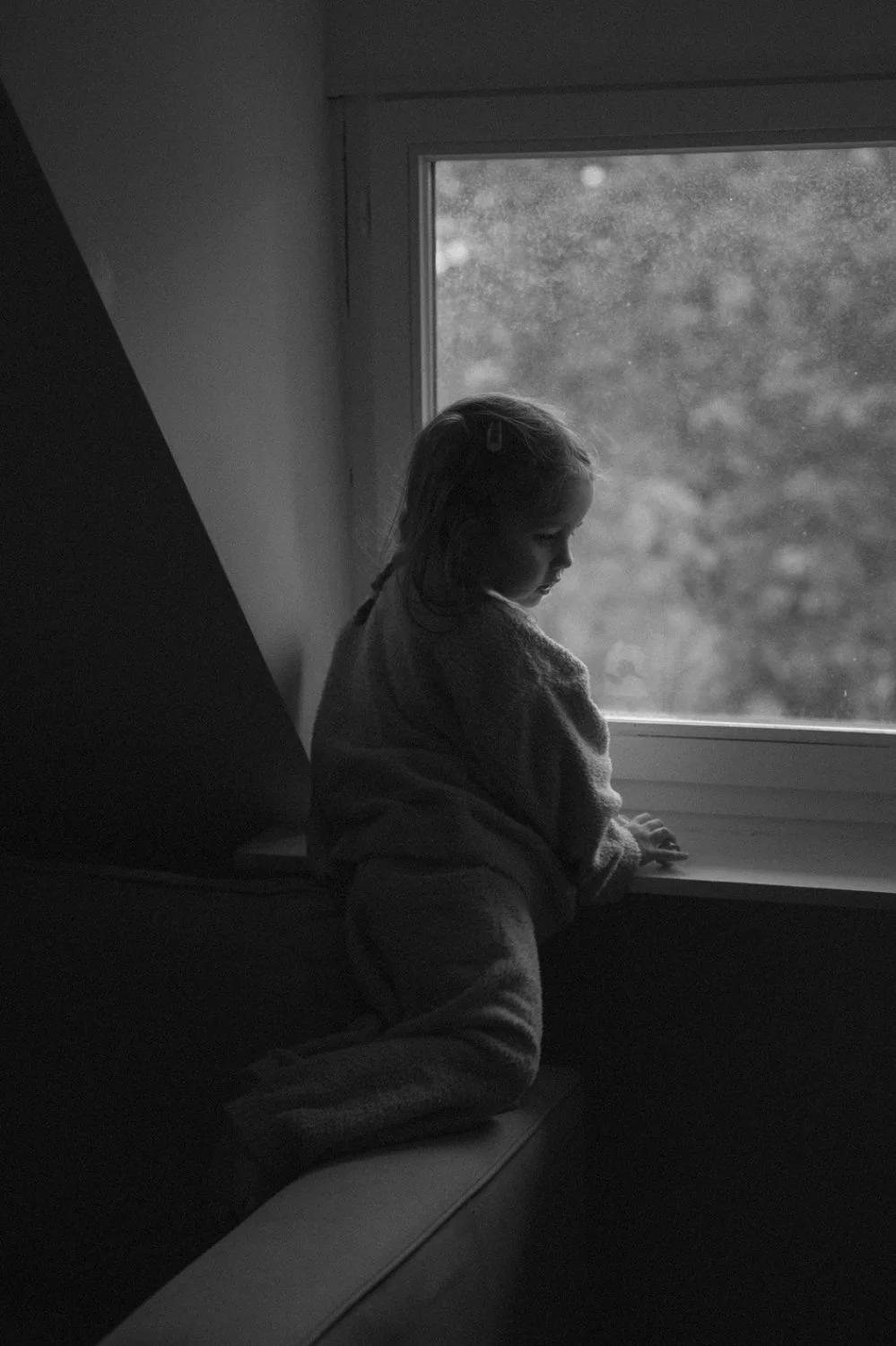
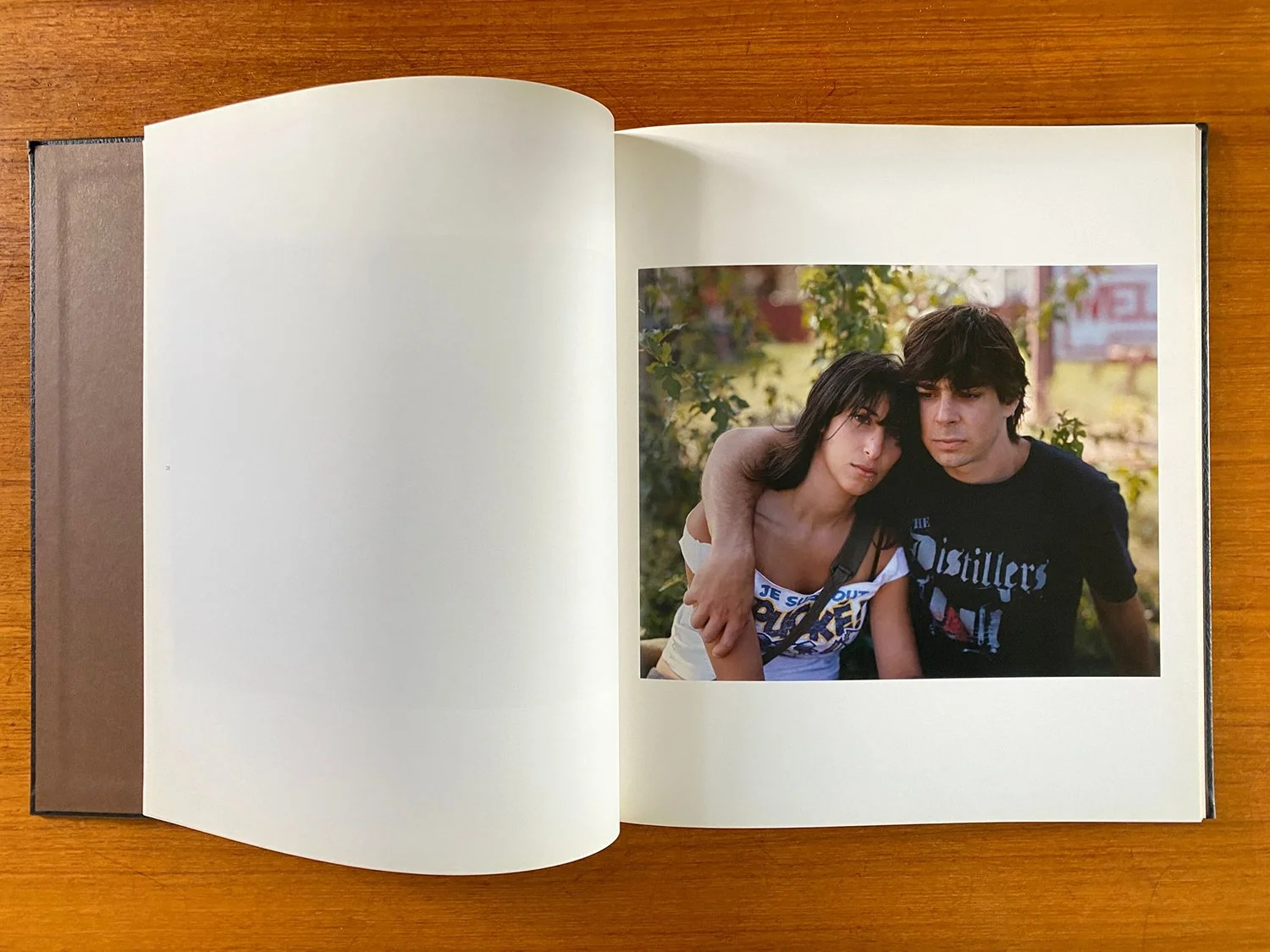
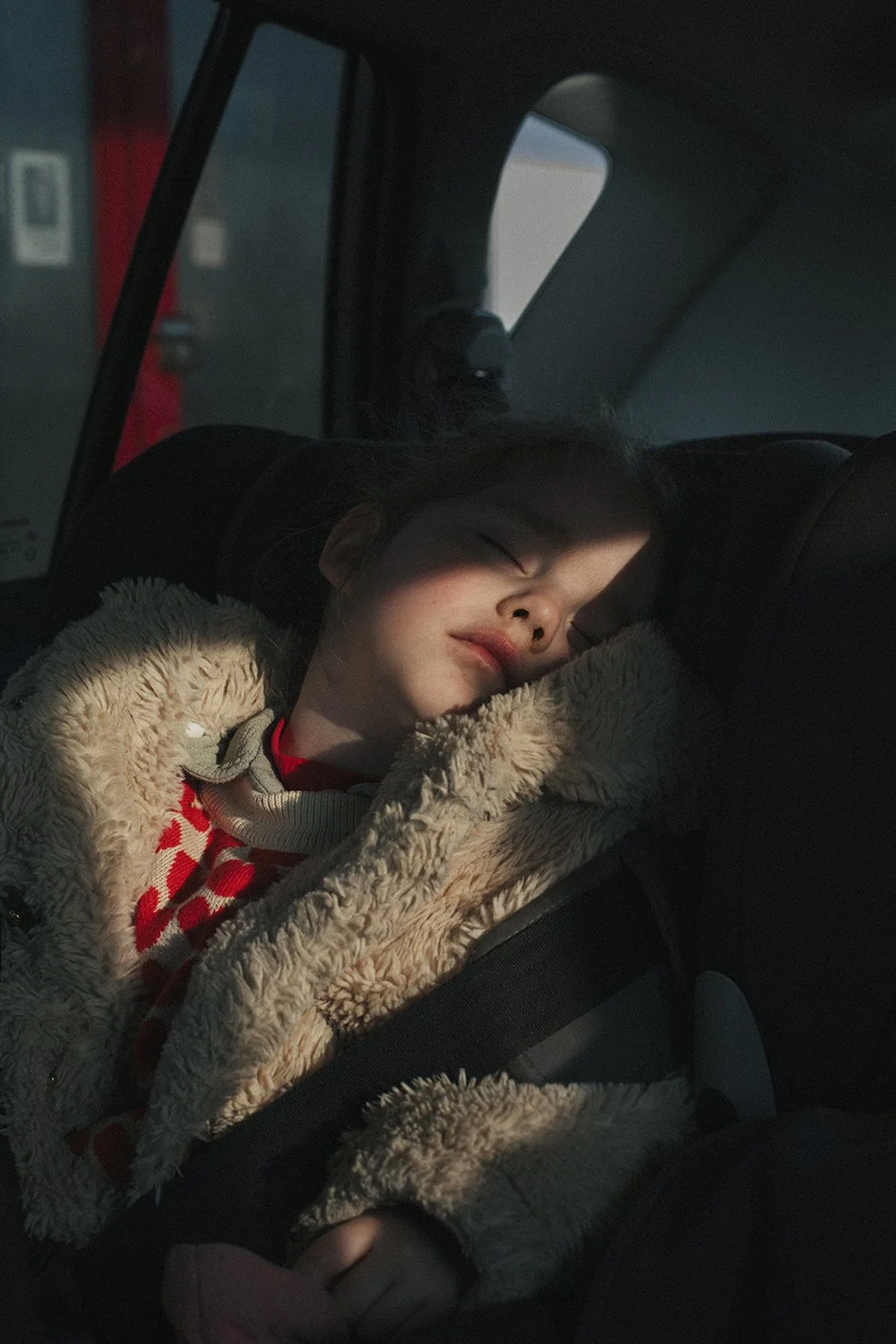
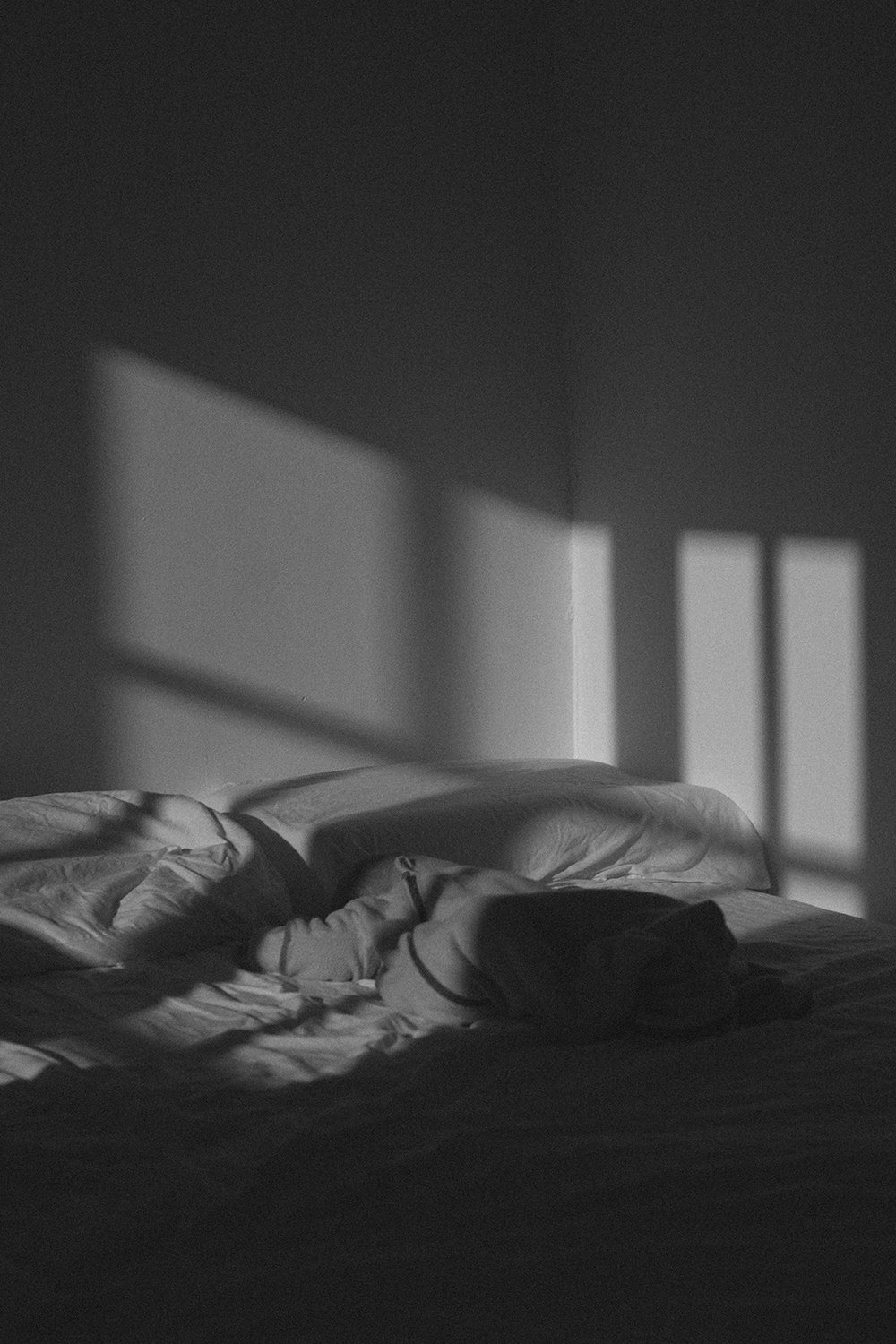
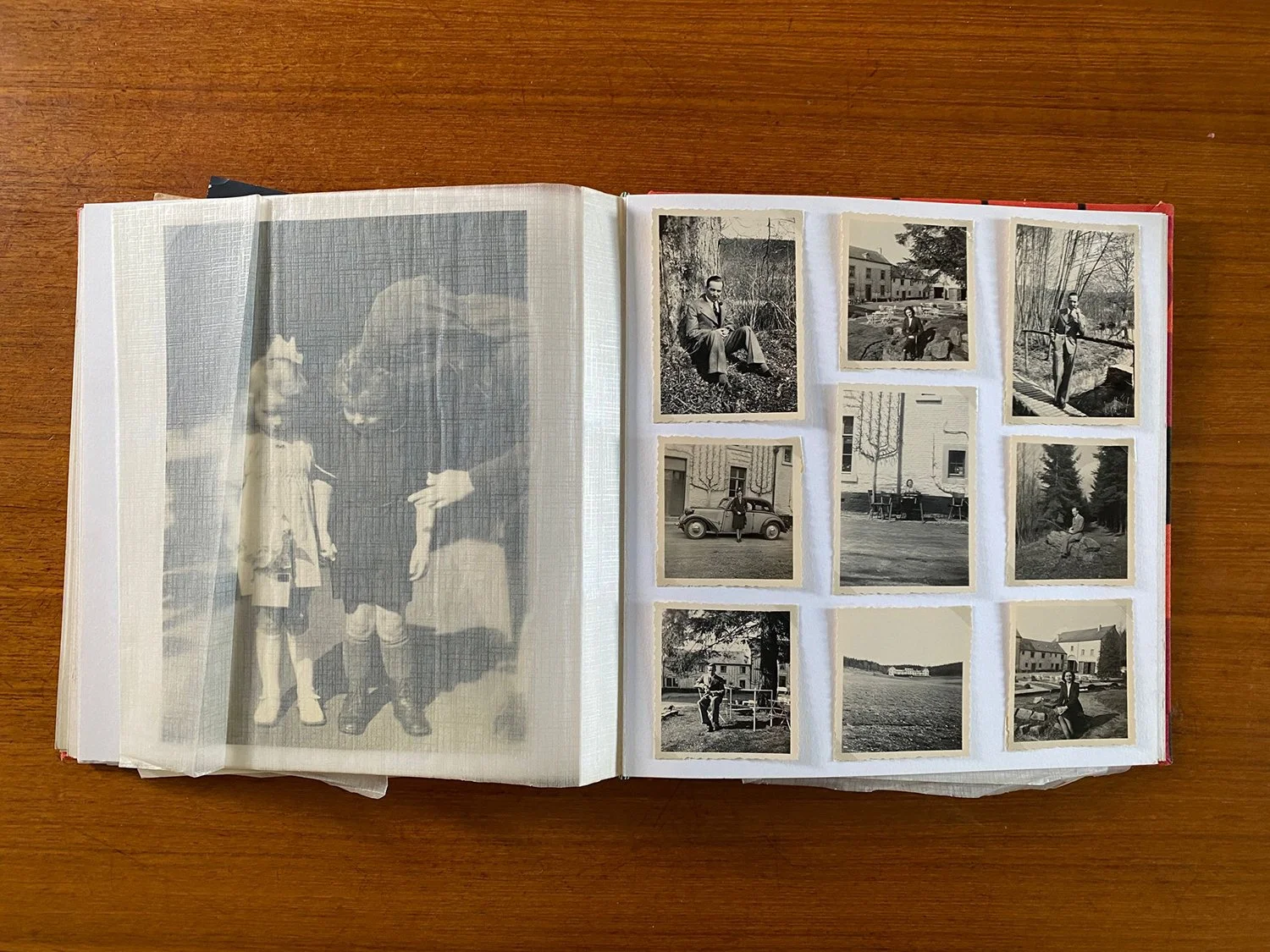
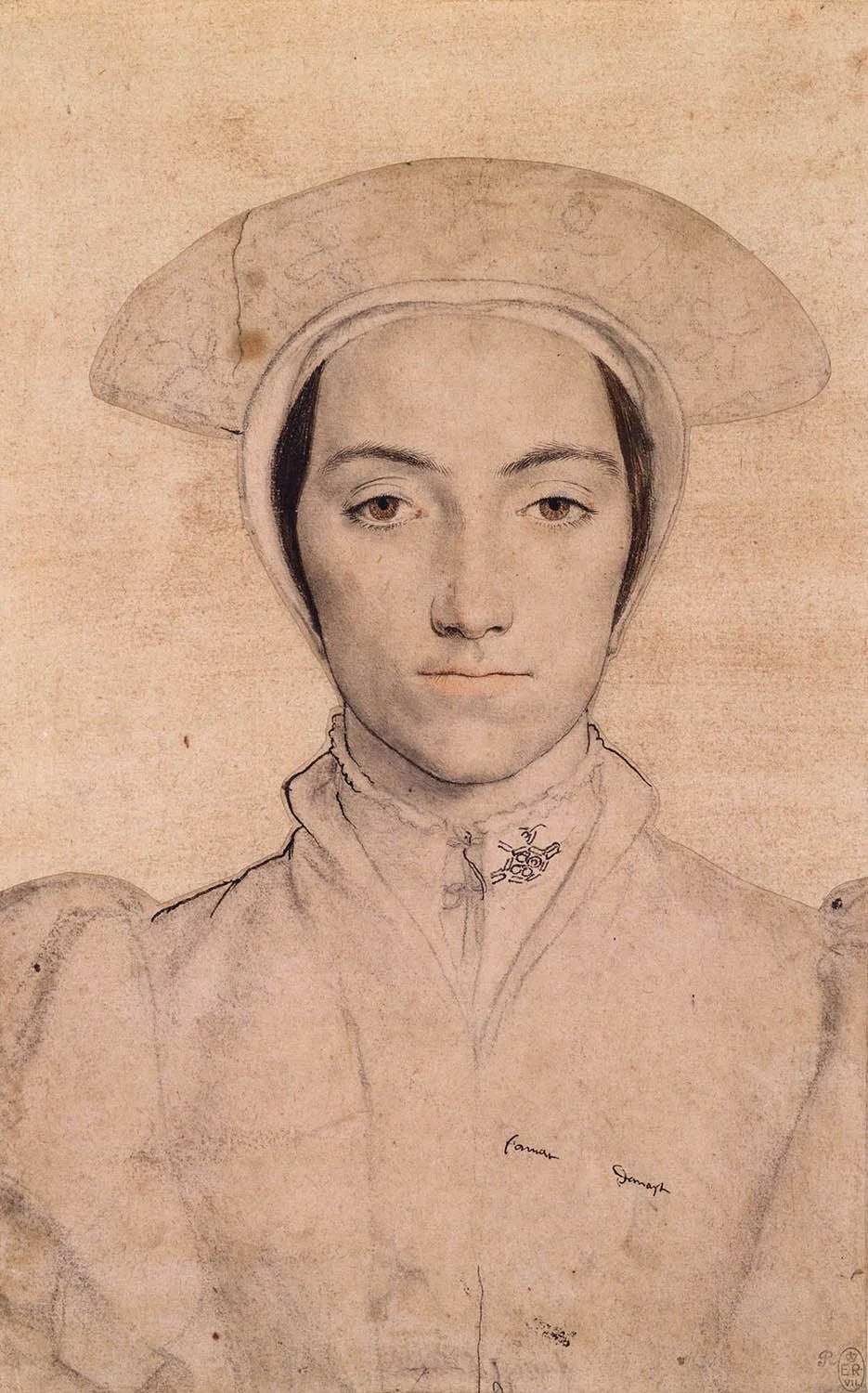
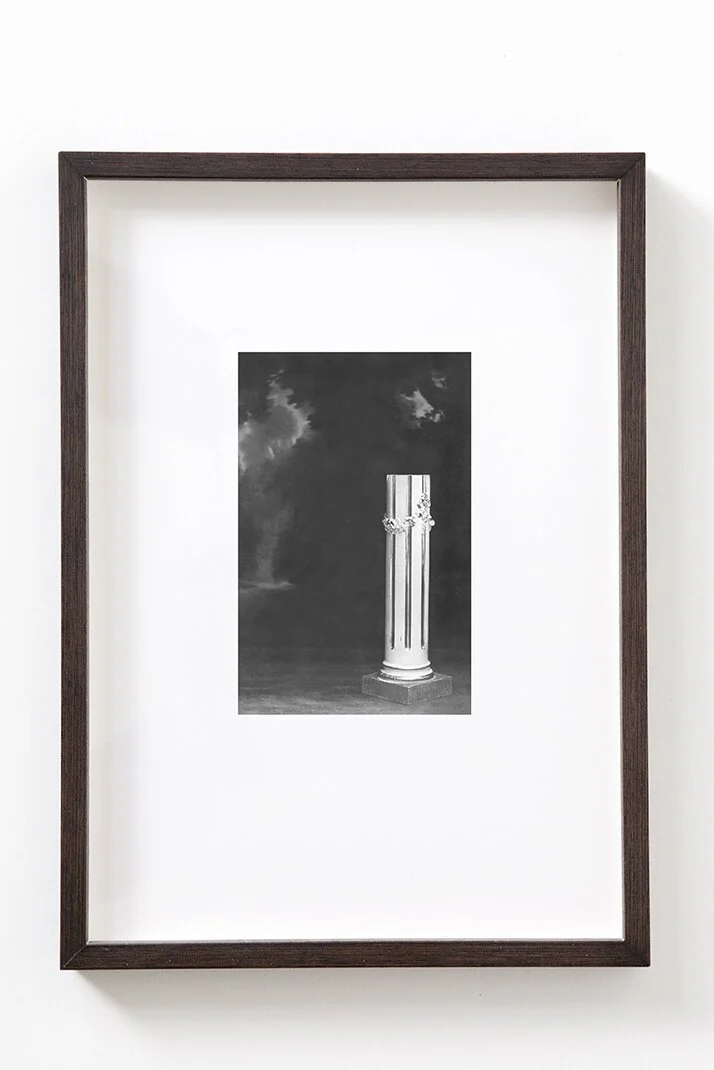
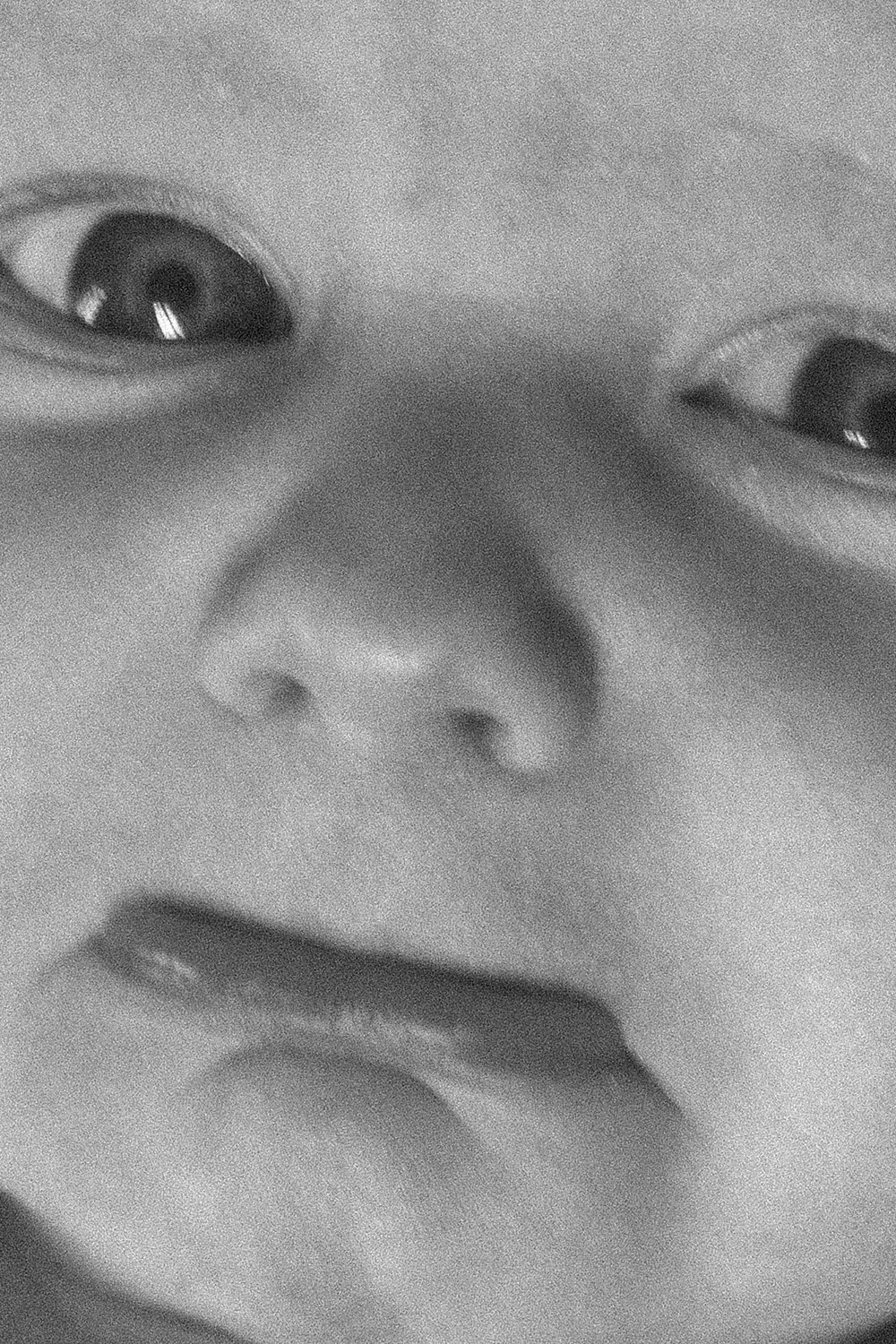

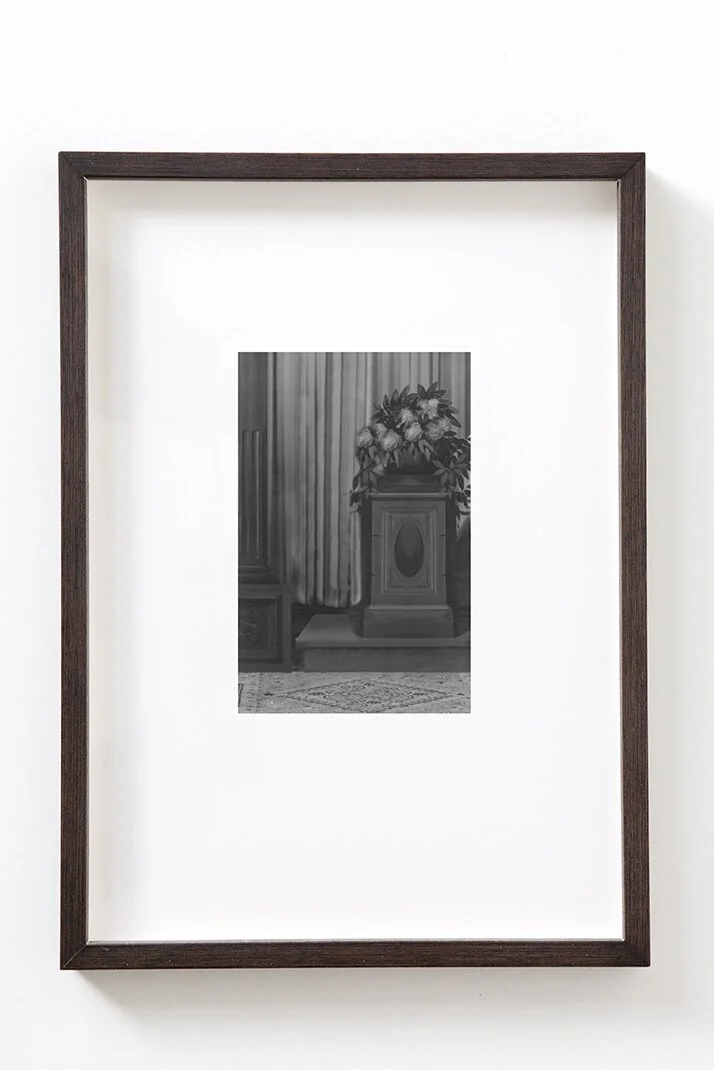
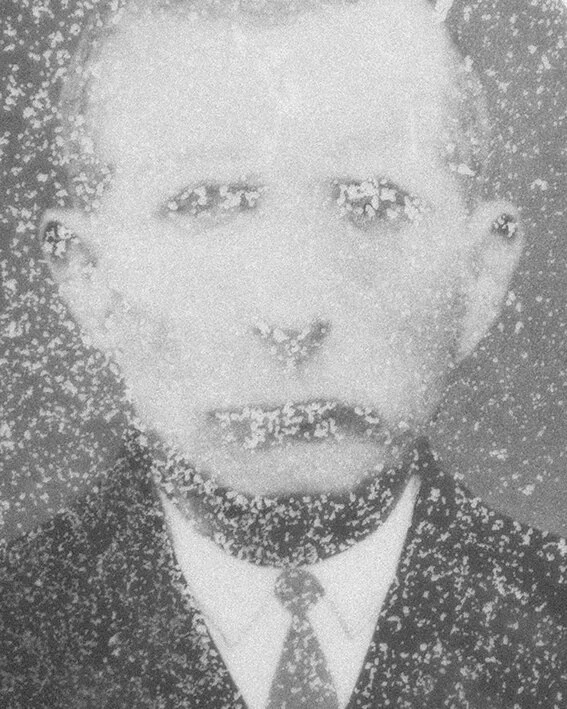
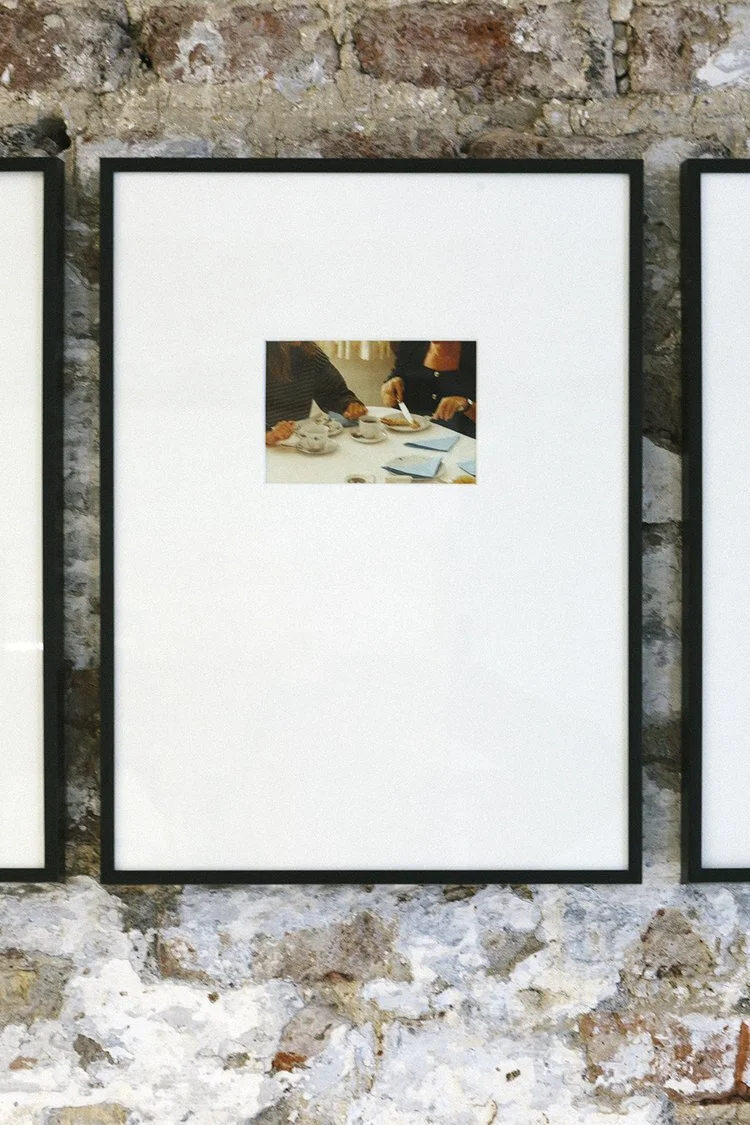
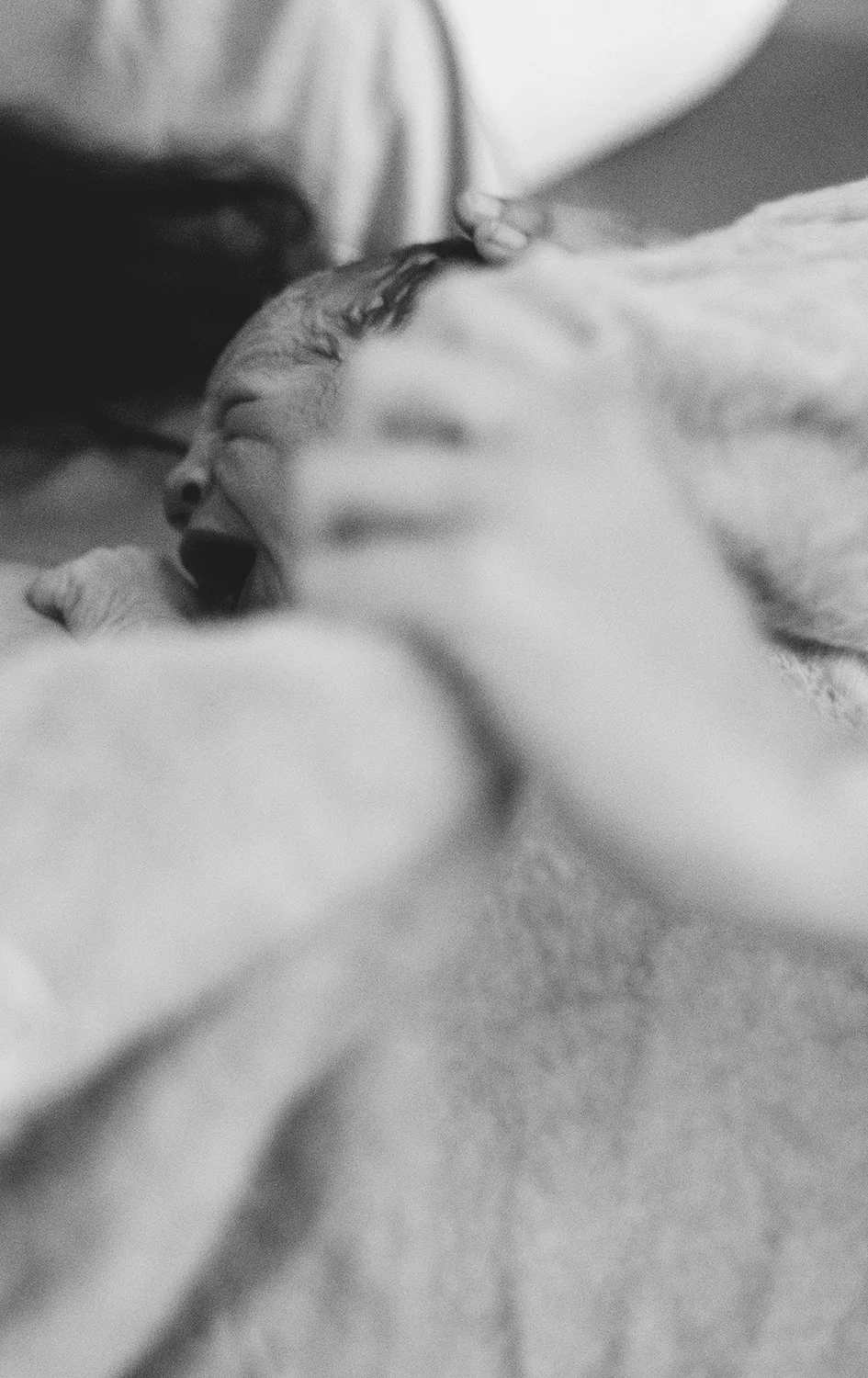
-
HM: If you were asked if you are a nostalgic person, what would your answer be? And has that answer changed over time?
JS: Reflecting on my emotions, I used to describe myself more as nostalgic rather than melancholic, if I remember correctly. Nostalgia is a more common word, so if people had asked me whether I was nostalgic, my answer would have always been “yes.” It’s not that I didn’t know the word melancholy though [laughs].
HM: No, the terms are often used interchangeably and, to be honest, I think some of your work is also, or could be labeled as, nostalgic, like An afternoon in May. Maybe some of your other work as well, if you define nostalgia as a backward looking emotion, an engagement with the past.
JS: I believe photography is inherently melancholic, yet simultaneously nostalgic. It is essentially nostalgic because, once a picture is taken, you possess a visual reminder that prompts you to revisit the moment when the photo was captured.
HM: That’s true. But when you say it’s inherently so, then it would almost follow that whenever the medium is used, nostalgia is going to be in play. I don’t know whether that’s true.
JS: Well, I agree that my statement isn’t entirely accurate in the sense that I’m specifically referring to a certain type of photography. There are various genres, and perhaps this sentiment doesn’t apply to all of them. I’m currently excluding abstract photography and experiments with lights in the darkroom and film from this discussion. However, when I teach photography to students, I often observe a pattern where first-year students, when tasked with a project, frequently choose topics related to memory. It may sound cliché, but clichés often exist for a reason. I find it interesting that the medium naturally lends itself to projects centered around memory. So, when I mention it being inherently nostalgic, I mean it in that sense; it’s a medium that naturally lends itself with those types of projects and ways of thinking.
HM: Yes. I think you’re right. -
HM: You mentioned that other photographers are also dealing with this theme or keep returning to it. And I was wondering, do you have any photographers that immediately come to mind or that for you are benchmarks or models of melancholy and photography?
JS: The first photographer that comes to mind is the well-known Magnum photographer, Alec Soth. His work exudes profound melancholy. If you watch him speak on YouTube, he delves into explanations about his work and other photography, revealing his own melancholic disposition.
Of course, there is a whole list of other photographers who evoke similar emotions. The medium itself carries a profound sense of melancholy, often intertwined with the theme of memory. My current focus centers on my interest in family photography. I find myself frequently capturing moments of my own children, attempting to preserve glimpses of their fleeting childhood, as time moves swiftly. The very act of doing so feels melancholic. In addition to photographing my own family, I also collect images of studio backdrops featuring individuals who are no longer present. It follows the same concept—people used to visit studios to have their portraits taken, intending to offer cherished memories to their loved ones. However, when I discover these pictures at flea markets, they are often discarded, with no one recognizing the individuals in the photographs. These pictures were initially taken to keep memories alive, yet when the last person who knew the subject passes away, their memory fades away too, unless they happen to be a widely known figure.
HM: Yes, I think that’s a very nice summary of the melancholic potential of photography. And I really like the fact that you’re actually pointing to two stages in which melancholy very much seems to be part of what photography is about. The first stage is that you realize that time is fleeting. That’s a harsh existential truth. As a result of that, you want to hold onto something that is dear to you. But then there’s the second stage where you’ve made the picture, you’ve tried to hold on to this fleeting moment, but then you realize that this moment and the depicted person will be eventually forgotten. And so there’s another bit of melancholy there where you realize that the very attempt to hold onto to something of the past, is ultimately futile in photography.
JS: I’m currently working on a project that aligns perfectly with these sentiments. The loss of my mother to suicide when I was 15 has left a lasting impact. Last summer, while going through pictures with my four year old daughter Luna, she pointed to images saying, “Oh, that’s Opa and Oma.” saying they are my parents. So I had to explain to her that while they are her grandparents, her grandmother is actually not my mother. She then asked about my mother, and I had to navigate the delicate task of explaining her absence.
With this poignant moment in mind, I found myself contemplating how to guide my children through this absence? How do I convey who my mother was—highlighting both her virtues and flaws—when they’ve never met her? These questions led me to embark on a project: creating a book about my mother. I’m currently gathering memories from various sources, including my brother, my mother’s sister, her friends, and even childhood friends who knew her.
However, the challenge arises in photographing someone who is no longer alive. To address this, I plan to enlist other mothers to stand in for those pictures. My own children will also play a role; I’ll involve them in activities like painting their nails with my mother’s nail polish and capture those moments. So that’s a profoundly melancholic project in the making; revolving around the essence of memory, how it changes, how we desperately try to preserve it, and how to convey it. -
HM: […] A photograph, let’s say, can express a certain emotion. It can also elicit that same emotion, which is different. So if we’re talking about melancholy, melancholy can be the emotion that the artist has and then tries to express via the photograph. But also, melancholy can be the emotion that is elicited in the viewer, even though it was not on the mind of the photographer. And then thirdly, a photograph can be expressive of melancholy when it gives the viewer an idea of what it’s like to experience melancholy.
The reason why I wanted to come back to that is because it ties in with artistic value and artistic achievement. When we talk about nostalgia and melancholy, I think a lot of photographs elicit those emotions irrespective of whether they were intended as such and irrespective of any skill.
A nice example is old family albums one may find on a flea market. I know Julie goes to a lot of these secondhand markets and often picks up such old photo albums. No one may remember who the people in the photographs are. Many of these photographs are not skillfully made and they were never made with the intention to elicit melancholy or nostalgia, but they do.
And I think that’s one thing: to think about photography as the medium that elicits these emotions, even if that was never the intention of the maker of the photographs. But it’s quite another thing to have a photographer like Julie, who wants to express that emotion and then manages to create work that brings that emotion about in the viewer in a way that is illuminating. So that’s why I’ve been interested in Julie’s work; her work is truly expressive of melancholy, it doesn’t merely elicit emotion. -
JS: Μelancholy is such a loaded word and I was wondering what were the other words you were thinking about when you started?
HM: In the beginning I was just interested in certain moments of bittersweet profundity that had moved me deeply in my engagement with art works. But I didn’t have a label for that experience yet. It wasn’t even clear to me whether it was one experience that I was thinking about; because alongside 16th century renaissance portraits, where you have the feeling that the person in the portrait is looking back at you, I was also moved by certain novels and particular films or songs. And it wasn’t entirely clear to me whether it was always the same thing.
When I started thinking about it, philosophically, the terms that initially came to me were “melancholy” and also “nostalgia”. But I quickly realized that it wasn’t nostalgia I was after, since many of the experiences I had in mind weren’t backward looking. Then there’s the term ‘being moved’. When we use it in everyday situations, we may think of it as some vague, indeterminate feeling. You are touched by something, but you cannot specify the precise emotions you are feeling. But I read some recent philosophical work on what it is to be moved, and am now persuaded that it is a quite specific emotion, with a very distinct profile, just like jealousy or just like nostalgia. And I think many of the experiences that I’ve been interested in are examples of being moved. But when I started honing in on the particular experience that was most central to my own engagement with art, and I asked myself what it is that I find valuable in the works that truly struck a chord with me, I found that melancholy was the most suitable term. Having said that, you are right, it’s a term with a lot of historical and theoretical baggage. So I’ve been thinking that perhaps I should focus on the notion of ‘bittersweet’ in my future work. That makes things simpler.
JS: I’m currently working on a project that aligns perfectly with these sentiments. The loss of my mother to suicide when I was 15 has left a lasting impact. Last summer, while going through pictures with my four year old daughter Luna, she pointed to images saying, “Oh, that’s Opa and Oma.” saying they are my parents. So I had to explain to her that while they are her grandparents, her grandmother is actually not my mother. She then asked about my mother, and I had to navigate the delicate task of explaining her absence.
With this poignant moment in mind, I found myself contemplating how to guide my children through this absence? How do I convey who my mother was—highlighting both her virtues and flaws—when they’ve never met her? These questions led me to embark on a project: creating a book about my mother. I’m currently gathering memories from various sources, including my brother, my mother’s sister, her friends, and even childhood friends who knew her.
However, the challenge arises in photographing someone who is no longer alive. To address this, I plan to enlist other mothers to stand in for those pictures. My own children will also play a role; I’ll involve them in activities like painting their nails with my mother’s nail polish and capture those moments. So that’s a profoundly melancholic project in the making; revolving around the essence of memory, how it changes, how we desperately try to preserve it, and how to convey it. -
HM: Bittersweet is such a cliché term, but within philosophy not much work has been done on this. I think that’s a missed opportunity. Because I don’t think people realize enough, the huge complexity of bittersweet experiences that are out there. When you say goodbye to someone, that’s often a bittersweet experience. But that’s different from the bittersweet experience of nostalgia. It’s different from the bittersweet experience of melancholy. It’s different from the bittersweet experience of being moved, say, by a wedding. (Not that I’m usually moved by weddings, but some people are moved by weddings.) All of these experiences are bittersweet, but they are so in different ways. And I think it would be super interesting, philosophically speaking, to think more about that—especially also in an artistic or aesthetic context; because much like the term “taste” which has been crucial in the development of Western aesthetics, the term “bittersweet” finds it origin in one of the senses. Let me explain this a bit more.
Taste is one of the five senses. But we also talk about taste in pictures, taste in fashion, and so on. Taste has become synonymous with aesthetic engagement or aesthetic judgment in general. Immanuel Kant, who arguably wrote the most influential work in the history of aesthetics, talks about aesthetics judgments as “judgments of taste”. For example when you find something beautiful, that’s a judgment of taste. So he uses the term “taste”, which derives from one of the senses, to talk more broadly about beauty in general. (As an aside, it’s a bit ironic that for a lot of philosophers, including Kant himself, a literal taste experience cannot be beautiful. For them, beauty is limited to the realm of vision and hearing. Smells, textures, tastes can be agreeable, but not really beautiful. But that’s just an aside.)
Coming back to the bittersweet, things are very similar. The term “bittersweet” relates first and foremost to one of our senses, namely the sense of taste. But it’s come to be used much more broadly, and may refer to a wide variety of aesthetic experiences that involve the other senses as well. Julie’s photographs can be bittersweet. Music can be bittersweet. Films can be bittersweet, though not literally, of course.
So, there’s an interesting parallel that goes to the heart of what aesthetics is about and that deserves to be looked at more closely. -
HM: So there’s nostalgia, which is typically understood as a backward-looking longing that causes a bittersweet feeling; sweet, because you’re thinking about something nice in the past; bitter, because the past is gone. That’s nostalgia as we know it, and it will often occur when we look at old pictures, and certainly old family photographs, and we think about this nice past that is no longer here. But there’s also another form of nostalgia, one that comes very close to what I understand melancholy to be, namely: anticipated nostalgia. This occurs not so much when you’re thinking about the past, but when you’re looking at the present as if it is the past; when you anticipate being nostalgic about the moment here and now. This is a very peculiar state that has been studied in psychology recently. What is interesting about it is that it seems a combination of backward looking and forward looking. So when you said about photography that it’s inherently nostalgic, that’s not too far off the mark, if we understand nostalgia broadly enough, to include something like anticipated nostalgia. What do you think?
JS: It’s amusing because I see a reflection of myself in that scenario when I photograph. Family photography tends to capture a lot of joyful moments or carefully staged happiness. Personally, I find myself attempting to capture pictures of my kids in moments of distress—yes, even when they’re crying [laughs]. There’s this anticipated nostalgia you mentioned, where I think, “Oh, she’s so tiny and helpless,” and in that split second, I rush to take a picture before offering comfort. It’s my way of wanting to remember those unfiltered moments and looking back on the beauty of them [laughs].
HM: That’s interesting that you just said that. In your practice as a photographer, are there ever any moral qualms, like when you take a picture of your child before you comfort her? Is that something you struggle with?
JS: That’s a perpetual struggle for me. I don’t usually capture moments of them crying, but whenever they fall, there’s this instinctive thought that it could be a poignant picture—my little kid with those big tears, you know? I contemplate reaching for my camera, and in that fleeting millisecond, there’s a moral struggle. Ultimately, the parental instinct wins, and I choose to comfort them rather than taking a photograph. So, the rare occasions when I do have pictures of my kids crying, it’s because the camera was already in my hands from previous shots.
I don’t have so many pictures of them crying, you know, [laughs]. But I do try to make pictures of moments that are less commonly photographed but in my opinion are at least as valuable to cherish. I have made some self portraits in the middle of the night in the light of my kids nightlight of me looking tired and slightly frustrated by the fact that I was woken up by one of them for the third time that night for example. It’s something one could argue you’d want to forget as fast as possible, let alone have photographic proof that it ever happened, but for me it serves as a reminder of how my kids needed me. and I make these images with anticipated nostalgia in mind, of how one day they will no longer need me to comfort them at night and I will look back on our nightly adventures and lack of sleep with a certain fondness. -
HM: Some people consider nostalgia a categorically inappropriate emotion. So they argue that there’s always something slightly wrong or off about nostalgia because they see nostalgia as necessarily involving an idealization of the past, and therefore a distortion of the past. You idealize the way it was, in order to be able to indulge in this bittersweet feeling.That’s another reason why, in the end, I prefer to think of melancholy rather than nostalgia. Because melancholy, as I understand it, does not involve a distorted picture of reality, but rather the opposite: you come to see the harsh reality of human existence as it really is. Whereas the distortive aspect about nostalgia is something I would want to avoid, I do welcome and even seek out the clarity that those profound moments of melancholy bring. Then again, unlike other theorists, I don’t believe that nostalgia necessarily and always involves a distortion of the past. But I don’t know what you think?
JS: What I was going to say is that memories are always distorted. I mean that’s just how memory works. You don’t remember things as they are.
HM: Fair enough. But memories can be more or less truthful, no?
JS: But then you go back to the question of “what is the truth?”. Because my truth is not your truth. And if we have a mutual memory and if we end up in a situation that we’re in together and we both look back on it, we’re both going to tell a different story about it.
HM: Sure. But I do think that stories of what happened can be more or less accurate. Let me give a fictitious example. Let’s say, I’m reminiscing with some friends about this young man we once knew who passed away. And I say: “he was such a happy-go-lucky character”. But my friends correct me and point to the fact that he had long bouts of depression and often sat alone by himself crying. And so then I come to realize, that yes, in fact my picture of the past was distorted. My friends’ picture of our mutual acquaintance is more true to the facts. It’s just a quick example, but won’t you agree that sometimes people’s memories can be more or less accurate, or more or less distorted?
JS: I don’t know. For me, I think memory is always a distortion and it can be more or less accurate. But then again, what is accurate? Because they’re remembering the times he was depressed, but I am sure he wasn’t depressed his whole life.
HM: But in that case, doesn’t it seem more accurate to say that sometimes he was happy and sometimes he was sad; instead of just claiming that he was a happy-go-lucky fellow?
JS: Yes. But saying that he was sometimes happy and sometimes sad, that describes the whole of humanity.
HM: Right! [laugh] I’m not saying that memory can be a hundred percent accurate or that memory is like a clear window through which we see the past with no distortion whatsoever. So let’s forget this example. Let’s talk about politics. We’re all aware of these rightwing nationalist parties in Greece, in Belgium, in the UK, which have become more radicalized and more popular in recent years. A real threat, I think. Now, a common feature of many of these parties is a glorification of the past. They’re nostalgic for some sort of past that, once you start digging and pressing, you discover is a fiction. It’s an idealized past that never really existed. I believe it’s important to point that out. But in order to point this out, you need to be able to say that sometimes our version of the past can be more or less accurate. Because if you start by saying it’s always distorted, you cannot criticize them for holding a view—of reality and of the past—that is false.
JS: I see where you’re getting at. I agree to that part but, but don’t necessarily think that saying that our past is always distorted fives them a free pass to distort it. Instead, I would characterize it more as idolizing the past. We’re all aware that this idealized version isn’t entirely true [laughs]. However, I don’t see this acknowledgment as a reason to establish a broad consensus. It allows room for us to sometimes assert that, no, the past wasn’t exactly as romanticized. I might not be explaining it perfectly, but that’s the gist.
HM: No, not at all. But it’s not the first time these conflicting intuitions come to the fore. In the art world, it’s a very popular view that there is no such thing as objective reality or truth. It’s all relative, a matter of subjective perspective. Whereas in philosophy, at least in analytic philosophy, subjectivism and relativism are not the dominant views. I also tend to be more of a realist. As a philosopher, I certainly don’t want give up all talk of truth and accuracy. And that often clashes with my art students, who are much more persuaded by the subjectivist and relativist position. And I think that’s okay. It’s actually a very healthy approach to have when you’re dealing with art, or when you’re making art. But as a philosophical position, if it comes to the strength of the arguments and theories, I don’t think extreme relativism or subjectivism are very compelling views. But now I’m going on too long about something that might not be relevant. But I hope that you see what I’m getting at.
JS: Yes, of course, and I find it very interesting. -
HM: There is something about the particular and the universal which may be added here. So when I think about your series An Afternoon in May, those are photographs of meals and festivities that took place in the 1980s or 1990s, is that right?
JS: Between 1950s and 90s.
HM: And are they photographs of your family or just found footage?
JS: It’s a combination of both.
HM: Okay. I was going to say that in An afternoon in May, some of the photographs will relate to events that Julie was present at or has some memories of. So she could be nostalgic for that time—a time in which, for instance, some of her deceased relatives are still alive. But then, of course, when I look at these pictures, they don’t concern me directly. It’s not my family. So one might think that it will be impossible for me to become nostalgic as a result of these pictures. After all, I didn’t experience these meals or festivities. It’s not my past. And, yet, I can and I do experience nostalgia. That’s partly because I was alive in the seventies and eighties and nineties and so these pictures remind me of my own past and of my own family dinners. They were not too different from the dinners in Julie’s family. But then it would be interesting to think about millennials, or people who are born in the 21st century, and whether they can become nostalgic when they see Julie’s series. Can they come to feel this for a time that they never experienced? I actually think the answer is “yes”. One can become nostalgic for a time that one has never experienced oneself. And photographs are quite good at evoking such a feeling. But also the skill of the photographer comes in here, I think. With really good photographers, like the one that I’m having this conversation with now, they’re often able to make something that is very particular to them universal. That’s kind of the magic of great art; that it just doesn’t just speak to this one person.
JS: I want to add to that point, especially since you’re discussing time. My hope is that millennials and others can see themselves reflected in this work. My primary aspiration is that the work transcends the time in which it was created. As an artist, there’s a desire to create work that people can relate to, and that’s especially true for me. I aim for a universality that extends beyond my family, which is why most of the pictures in An Afternoon in May are found footage.
What resonates with me about this collection is the universal aspect of people simply sharing a coffee together as a family, capturing that moment with a photograph. There’s a profound beauty in this seemingly mundane occurrence, accompanied by a heavy dose of nostalgia [laugh]. Ultimately, my wish is that the work surpasses the era in which these pictures were taken. I hope people, as you mentioned, Hans, can recognize themselves in it, connect with the moments depicted, and find resonance with their own lives.
-
PHOTOGRAPHER
Julie Scheurweghs lives and works in Brussels where she obtained a Masters degree in LUCA school of arts in 2010. After her first Solo Exhibition called “Accidentally on purpose” in Amsterdam in 2012 she quickly made her Belgian solo debut in Knokke and has had numerous solo and group shows since. Apart from being a photographer, Julie Scheurweghs is also an avid collector of photographs, both old and new, that have been discarded or even labeled trash. In her work, Scheurweghs uses these decaying images, disconnected from their original owners, as a medium to provide an intimate look into the personal lives of strangers and as a powerful metaphor for the ephemerality of human life.
juliescheurweghs.com -
PROFESSOR / PHILOSOPHER
Hans Maes is Senior Lecturer and Co-Director of the Aesthetics Research Centre at the University of Kent, United Kingdom. He is the editor of Portraits and Philosophy (Routledge, 2020) and author of ‘What is a Portrait? (British Journal of Aesthetics 2015). Other publications include: Conversations on Art and Aesthetics (Oxford University Press, 2017), Pornographic Art and The Aesthetics of Pornography (Palgrave MacMillan, 2013), and Art and Pornography (Oxford University Press, 2012). He is Vice-President of the British Society of Aesthetics and Past President of the Dutch Association of Aesthetics.
Interviews: Theopisti Stylianou-Lambert – Alexandra Athanasiadou
The Archive of Unnamed Workers by Theopisti Stylianou-Lambert and Alexia Achilleos is featured in the exhibition “The World Through AI”, currently on view at Paris’s Jeu de Paume (11.04–21.09.25). The project, as the artists explain, “attempts to negotiate the absences of archaeology-related photographic archives by creating numerous, fictional, portraits of Cypriot workers using Generative Adversarial Network (GAN) machine learning technology.” We caught up with Theopisti and here is what she shared over a virtual coffee chat.
Parmigianino, Self-Portrait in a Convex Mirror, 1524
AA: This project has the feel of “bending” space in a way, as if we are looking with a convex mirror, overtaking the flat surface and its linear narrative. It reminds me, if I am allowed to make a leap in time of Parmigianino’s Self-Portrait in a Convex mirror, a painting which disrupts Renaissance perspective and its orderly single point view of reality. Would you “see” the project operating like a convex mirror of sorts?
TS: It resonates with me. “Bending space” can be used as a metaphor for this project. And I would say that the space it bends is the archival space. The purpose of an archival space—whether physical or digital—is the organization, preservation and accessibility of material that are considered important. Our work creates an alternative photographic archival space that highlights omissions in existing archives. In our case, it highlights the under-representation of workers in archaeological work in colonial Cyprus.
So in that sense, yes, it bends the archival space—and the perspective through which we see archaeological work. When we examine archaeology in colonial Cyprus, we examine it through a particular perspective: that of male foreigners who came to Cyprus as archaeologists or explorers, seeking knowledge or money. It’s a very specific perspective, and that’s the one we find in archives. It’s their “standpoint”—physically and metaphorically. They chose where to stand, what to photograph, what to include and exclude in the photographic frame and all based on their own interests and assumptions.
Theopisti Stylianou-Lambert & Alexia Achilleos, The Archive of Unnamed Workers, 2022, GAN-generated images on 35 mm glass photographic slides (reversal film), dimensions varied
AA: Would you also say it bends the perspective of history writing—going even beyond the archive? I mean, seeing the larger picture: the archive is part of the historical narrative, but could this also be a methodological tool for revealing a “bent” narrative in history writing? Or for uncovering smaller, overlooked histories, since bending space allows more perspectives to emerge? Would you extend this idea beyond archaeology and the archive, into history and history writing?
TS: Yes, you can say that. In fact, the next project we collaborated with Alexia—The Archive of Grigoris Antoniou—does exactly that. It identifies a real person, Grigoris Antoniou, who was pivotal in Cypriot archaeology, and attempts to reconstruct a speculative, fictional archive from his own standpoint. So, we’re experimenting with this approach.
But it’s a fine line to walk. We are not aiming to create fictional archives that could later be mistaken for real ones, because that distorts history. Our project is relatively harmless—we’re focusing on invisible workers—but it could be dangerous to fill in historical gaps using, say, AI technology and present it as reality. That’s a real concern for me.
That’s why I always emphasize that our work belongs to the art ecosystem, not the archival one. It’s an important distinction. If archaeologists thought we were inserting fabricated material into historical gaps, they’d be alarmed—rightfully so. So, I’m very careful to frame this as an artistic practice—one that highlights omissions, and not actually fill gaps.
Theopisti Stylianou-Lambert & Alexia Achilleos, film still from The Archive of Grigoris Antoniou: notes of an archivist, video, 13:20 min. The artwork includes AI-generated images.
AA: At the same time, The Archive of Unnamed Workers “bends” time, as we examine imaginary images of the past produced in the present. This “bending” happens through a tool that leverages the phenomenal speed of digital processing to generate images that instead invite a slower, more deliberate engagement—ones that encompass the full picture and its multiple realities, resulting in more pensive, layered visuals. What’s your take on that?
TS: Yes, absolutely. For us, it was also crucial to return these images to a sense of materiality—something appropriate for a missing archive of the past. That’s why we chose 35 mm slide film and the Kodak Carousel projector. We wanted to ground these digital creations in something tangible, and in doing so, we didn’t just bend time—we collapsed it. We’re using a technology of the future (AI) to highlight historical power imbalances—ones that are already embedded in image-generated AI tools. At the same time, to return the images to the past, we sent the digital images to an old photo studio in Finland, where the images were developed on vintage glass 35 mm slides. Then, we carefully considered how to present them in a way that would encourage the kind of contemplative viewing you described.
AA: Would you consider “editing” one of the most powerful tools for artists working with AI-generated imagery? Should we shift our focus from making to editing—or, more precisely, to making in order to re-edit?
TS: That’s a very interesting question. It reminds me that with new technologies, many tasks traditionally tied to artistic labor are now allocated to machines. For instance, using an AI model to generate images allocates a significant part of the visualization to machines—but this isn’t new. Think of photography replacing painted portraits: the camera assumed the role of painters and it was initially resented for that. So, this is a historical reality. I guess the question we must ask is: Where exactly in the artistic process do we place value? Is it in a project’s conception, the technical execution, the creator, or the work’s reception? With AI-generated content, I believe the value lies primarily in the intent, the probing, and ultimately the selection and presentation. For example, in our work, we invested a lot of time in designing the concept, curating inputs for the GAN model, and selecting the final images. We carefully selected and cropped photographs of workers from various archives in museums that became the source for the GAN generated images. Then we meticulously selected just 40 images out of hundreds of GAN images. These selection processes were slow—arguably far slower than generating the images. We also deliberated over presentation details—the slide machine’s light bulb color, the box’s construction—and collaborated with curators. While we instructed the machine, the artistic value wasn’t in the image production itself. It was in everything around it.
Exhibition Views: State Gallery of Contemporary Art - SPEL, Nicosia, Cyprus. Exhibition: “In the Sea of the Setting Sun”, curated by Elena Stylianou, 11.22–02.23.
AA: But you see AI as a tool, right? Or are you interested in seeing how it might become more autonomous—where you give it more space to create, then take what it makes and fine-tune or re-edit? Not just the image itself, but maybe even the whole experience of processing artistic information —bringing something back and playing with that.
TS: At the time we are talking—it might change in the future—I see AI technologies as tools that allow me to do things that I couldn´t possibly do with photography or another artistic medium. They are complex and fast evolving tools, but still tools serving an initial intent. I know that other artists might talk about co-creation with AI technologies, but I’m not convinced. Any artistic tool or medium has possibilities and limitations, can surprise or frustrate you; AI technologies are no exception. As I always start with a concept or an intent, there are things I want to create that AI can’t do, and that frustrates me. Other times, I ask for something and AI gives me something completely different—but if it is interesting enough then I keep it or play with it a bit more. At the end of the day, it’s a kind of artistic play and negotiation. But at this stage, humans seems to always have the final say. Going back to your previous question, selection and presentation of a work are crucial human functions in AI generated works. If I didn’t have that control, it would take away my human artistic agency. And personally, that’s not something I’m willing to give up.
Exhibition views from the “The World through AI” at Jeu de Paume in Paris, France (11.04–21.09.25). Curated by: Antonio Somaini & Ada Ackerman. Photographer: Antoine Quittet.
-
PROFESSOR / RESEARCHER / VISUAL ARTIST
Theopisti Stylianou-Lambert is an artist and researcher, serving as a Professor in the Department of Multimedia and Graphic Arts at the Cyprus University of Technology. She is also the co-leader of the “ITICA/Museum Lab” at CYENS Centre of Excellence. In her work, research and art practice are interwoven and one informs the other. She is fascinated by the nature of photography (especially everyday photography), archives, museums and the interrelations between photography, archives, museums and new technologies. Her artistic work has been showcased in numerous exhibitions in Cyprus and internationally. She has an extensive publication record on topics related to museums and photography. She co-authored “The Political Museum” (Routledge, 2016) and edited notable volumes such as “Museums and Technologies of Presence” (Routledge, 2023), “Museums and Emerging Technologies: Mediating Difficult Heritage” (Berghahn Books, 2022), “Museums and Visitor Photography” (MuseumsEtc, 2016), “Museums and Photography: Displaying Death” (Routledge, 2017), and “Photography and Cyprus: Time, Place, Identity” (I.B.Tauris, 2014). She serves on the advisory committees of the peer-reviewed journals “photographies” and “Visitor Studies” and is a founding member of the International Association of Photography and Theory. During the academic year 2025-2026, she will be the Moa Martinson visiting professor at the Linköping University in Sweden. -
PHLSPH
Dr Alexandra Athanasiadou works at the intersection of visual practice and philosophical inquiry. She is the founder of the PHLSPH Lab: Image Thinking Lab.
For fifteen years, she has worked with images—inside museums, galleries, and universities, but never quite contained by any of them. Her route through the photography world has taken her from the Museum of Photography in Thessaloniki to Candlestar in London, from European platforms like Transeurope PhotoProject to curating and setting up a photography award with IOM Central Asia, from a research program at the University of Crete to her current roles as a Special Scientist at the Technological University of Cyprus, an external tutor on the MA Photography and Society at the Royal Academy of the Arts in The Hague, and a teaching position at the School of Visual and Applied Arts, Aristotle University of Thessaloniki.
Along the way, she built something between the usual categories: a practice that draws on academic training (a PhD in Aesthetics; the Courtauld; Oxford; Panteion University) but refuses to stay in its lane. The work sits at the edges—close enough to both the art world and the academy to know their rules, far enough in to move freely between them.
Interviews: Richard Whitlock – PHLSPH
Following up on Richard Whitlock’s article “The view from nowhere: Exploring parallel projection in photography” in the Philosophy of Photography Journal and in an attempt to connect conversations in present tense (more or less) we met up. Here are some excerpts from our conversation aiming to have a peek into the atelier of Richard’s mind.
Richard Whitlock, Studio Wall, 2009, inkjet print 142 × 243 cm
AI version generated by ChatGPT from the Alt Text of Studio Wall, 2024.
-
PHLSPH: We are surrounded by photographic images which represent a non-existent normativity—a world tidied up, as it were. Would you say that the images you make try to highlight this gesture and resist it?
RW: Tidied up and also impenetrable, self-contained. The space of the photograph is seamless, its perspective perfect, everything precisely arranged around a vanishing-point always at dead center. My thought was that this perfect photographic reality needs to be challenged from within photography itself, as it is photographic space that we think of as real, more or less. Paintings, for example, are ‘art’, so not real anyway. So I started to make photographs and videos that look normal but do not have the perspective structure you expect in photographic media. I discovered that disobeying the ‘laws’ of perspective brought back something of the freshness of a child’s vision of the world.
Photography is being replaced by AI, but photographic space still reigns, as the billions of images genAI correlates are mostly photographs. AI tries to please, to give you what you expect, so it produces a normalised pictorial space, even if some of the content is a bit strange (six fingers, extra legs). I asked ChatGPT to make a picture in parallel projection, without perspective, using as a prompt the Alt Text of one of my flat pictures and it produced the following image with a highly constrictive central perspective.
Installation of The Street (HD video, 10-minute loop, 2012) at Queen’s College, New York, 2014.
The Street (HD video, 10-minute loop, 2012)
-
PHLSPH: Over our coffee you mentioned what Eric (the janitor) said when you installed your work in Queen’s college, New York: “For a minute I thought it was in real time”. Would you say that this image is indeed “in real time”?RW: Real time means what is happening now, as in surveillance camera footage. Eric knew all about real time as he was under constant surveillance from cameras in the foyer of the art department where he worked. He was not allowed to sit down even for a moment and rest his poor arthritic legs. The Street seems like a real scene, as though taken by a video camera, but in fact it is constructed from many videos and photographs taken over many months. So it was not in real time at all, as Eric quickly understood, but shows many different times running concurrently. This enriched time, strangely enough, seems to have a strong feeling of reality, the feeling that something is really happening right now.
The Philosophy School, 2024, 4K video, 4-minute loop.
-
PHLSPH: What is the relationship between time and space that you wish to draw our attention to?
RW: My intention was to flatten space, but I discovered on the way that altering space alters time as well. I had always thought of time as the fourth dimension, moving space steadily into the future, as we learned at school. But flattening space meant all the elements in a picture had to be taken out of the scene, deperspectivised, and recombined in two dimensions. So, different ‘times’ started to run concurrently, woven together. Not only different moments in historical time, such as yesterday or a month ago, but times that ran at slightly different speeds, often with little glitches, for example when the time-loops repeated. I tried to iron out these glitches, but slight imperfections always remained. The human eye is super-sensitive to any mistakes and irregularities, and I began to cherish these glitches. People really noticed them. They were like pegs they could use to build on, to construct their own reality.
Giotto, Confirmation of the Rule of St Francis by Innocent III, Upper Basilica of St Francis of Assisi, 1295, Wikimedia commons, public domain.
Courtyard in the Liu Yuan gardens in Suzhou, China, 1540—. From Stanislaus Fung, Non-perspectival effects in the Liu Yuan, The International Conference on East Asian Architectural Culture, Gwangju, Korea 10–14 Nov. 2015. Photo Liu Xu.
-
PHLSPH: If I were to visit the atelier of your mind I would find Byzantium and a lot of readings on Chinese philosophy and painting. Would you like to share how these two seemingly disparate worlds connect?
RW: The ancient Chinese and Greeks understood the principles of perspective geometry very well but disparaged its use in painting. Shen Kuo thought it too restrictive of the gaze, Plato that it was untruthful. I understood that space can be constructed in different ways from reading Florensky’s Reverse perspective, where there is a picture of St. Francis sitting with his monks before a pope. It is as if Giotto had taken the saints out of heaven and put them in the drawing-room, in perspectival space. The Byzantine aesthetic was about surprise, about using colours, sounds etc in unexpected, anti-naturalistic ways. In their psalmody, for example, they stressed words in unusual places to keep you on your toes. (AI does the opposite, giving you what you expect, smooth, clear meanings, teflon images that slide easily though your mind.) Chinese paintings, and gardens, have a tradition of destabilising spatial depth, of obstructing the speedy path through to the vanishing-point, here by using doorways to create, in Stanislaus Fung’s words, an “uncomfortable fracturing of the visual field”.
Ying Yujian, attr., Mountain Village in Clearing Mist, 12th–13th century, one of the Eight Views of Hsiao and Hsiang. These are dedicated to Wang Wei, Tang dynasty poet and painter. Handscroll. Tokyo, Matsudaira Collection.
-
PHLSPH: Are we “seeing seeing” through your compositions? Would you think that be a way to approach the images—as general and as abstract as it may sound in words?
RW: This question touches on the key issue of whether pictures generate ideas or ideas pictures. Can the intention, the thought behind a picture, be expressed as words? Chinese paintings were accompanied by texts, by poems, by commentaries written on the picture. They were enriched by words. But of course they could not be reduced to words. Art criticism tends to find meanings in pictures as though their purpose was to produce meaning. I think there is a pictorial logic beyond words. I wonder what you think about this, as your project of bringing philosophers and photographers together is exactly on this theme.
When I read philosophers, Heidegger, Plato, Nietzsche, it always seems to be about pictures, the way we picture the world. Do you find looking at pictures, perhaps photographs, that they are about philosophy?
Yes, I do. I am very interested in the thinking we do without words. And I think that the image is much more powerful than we give it credit for exactly for that reason. We have adored or despised it for obvious reasons over the passage of time, but I think that the true gold lies in the ways images are constructed by visual minds. In that light, there are images which shift our perception and our understanding of the world and could definitely be philosophical in a very condensed manner. Now, opening them up, or rather opening up the thinking processes underlying them would be closer to being about or even doing philosophy. And that could work in two ways: either because with their pictorial logic they shed light onto something which escapes or has escaped words or because if we were to unearth the thinking/visual processes put into their making we could shed more light in the thinking processes involved in abstract thinking. There is a lot more I would like to share about this, and hopefully more will appear on the LAB soon. Thank you very much for the question, though, and for touching upon the heart of the LAB’s mission and its areas of inquiry.
Image downloaded from workspaceforchildren.com, 2026
-
PHLSPH: How important is imagination for the making and the reception of your works?
RW: Imagination is what you use, let us say, when you play with wooden blocks and build a castle or a ship or a bridge or a pond. This is not like the kits that you can only make one thing with, an aeroplane or a space-ship or Joan of Arc, where you had to find how to fit all the pieces together in the right way. These kits are good training for making an IKEA table, requiring patience, skill, and an electric screwdriver, but not imagination. My pictures are, I hope, more like the wooden blocks you can put together as you like, to make your own thing with.
Drawing of my students drawing, ca. 2000
The Station (Cambronne metro station, Paris), 2024, 4K video, 6-minute loop.
-
PHLSPH: Would you say that your work has been infused with principles or your findings from drawing?
RW: Yes. After drawing for an hour or two, drawing from observation that is, you come out and see everything in a new light, a magical light. You can’t stop looking at things, and looking at people too, with an intensity you are not supposed to have outside the studio. Drawing takes you out of yourself and into other things. I found I was doing similar things with photography as with drawing, looking intensely at people, using architecture to structure the picture, and avoiding references and ‘meanings’. In this picture of a metro station in Paris, I took out the Eiffel Tower, a bronze lion monument, a rough sleeper, anything in fact that would provide a ready meaning or explanation, that would close the story.
-
Richard Whitlock is a visual artist, sculptor, and photographer. His work has been exhibited widely and presented in Afterimage, Photomediations Machine, and Philosophy of Photography. He studied Modern History and Modern Languages at the University of Oxford and Fine Arts at Brighton Art School. He has taught at the International University of Greece, the School of Art and Design of Saint-Étienne, and the American College of Thessaloniki. He lives in Greece.
Links
Here, you’ll find a curated chain of projects orbiting philosophical ideas—whether inspired by a thinker’s life, a facet of their work, or a specific concept. Each link leads to a unique visual exploration.
This space serves as a resource for researchers, curators, and fellow artists. The work featured here will also occasionally spark conversations and collaborations across other sections of the lab.
If your photography weaves philosophy into its fabric, we’d love to add your link to the chain.
Reach out at:
alex@phlsph-lab.com
![David Fathi [Auguste Comte]](https://images.squarespace-cdn.com/content/v1/698e2c6f2eae067e6e773875/1774095231305-PFNMGS4MJZY07ZQQ3WQ0/1.jpg)
![Jon Gorospe [Byung-Chul Han]](https://images.squarespace-cdn.com/content/v1/698e2c6f2eae067e6e773875/1774095231337-ONJ6H0ETKIYPKB6LI89D/2.jpg)
![Mustapha Azeroual [Gottfried Wilhelm Leibniz]](https://images.squarespace-cdn.com/content/v1/698e2c6f2eae067e6e773875/1774095235963-9KMSYLEKDC1L63UANI32/3.jpg)
![Arno Gisinger [Walter Benjamin]](https://images.squarespace-cdn.com/content/v1/698e2c6f2eae067e6e773875/1774095232388-TBBKCMJVCC2YO87XFFS5/4.jpg)
![Erik Berglin & Clement Valla [Bruno Latour]](https://images.squarespace-cdn.com/content/v1/698e2c6f2eae067e6e773875/1774095236673-79FHPHYRTTT4OQ93HISX/5.jpg)
![Fernando Marante [Martin Heidegger]](https://images.squarespace-cdn.com/content/v1/698e2c6f2eae067e6e773875/1774095235693-G5WSWHKSZT5WQPKPAKI8/6.jpg)
![Emilio Pemjean [Ludwig Wittgenstein]](https://images.squarespace-cdn.com/content/v1/698e2c6f2eae067e6e773875/1774095233848-Q6SGQUX85BMHFLAYNW1X/7.jpg)
![Maria Ahmed & Sarah-Jane Field [Vilém Flusser]](https://images.squarespace-cdn.com/content/v1/698e2c6f2eae067e6e773875/1774095234923-99GTKMC5OF95ZBZEOQXJ/8.jpg)
![Giuseppe Sannino [Jean-Jacques Rousseau]](https://images.squarespace-cdn.com/content/v1/698e2c6f2eae067e6e773875/1774095234421-SYFY51990OY4J0219B59/9.jpg)
![Claudia Hausfeld [Vilém Flusser]](https://images.squarespace-cdn.com/content/v1/698e2c6f2eae067e6e773875/1774095233418-1Y1UEXIAY2FIYZ36IER3/10.jpg)